
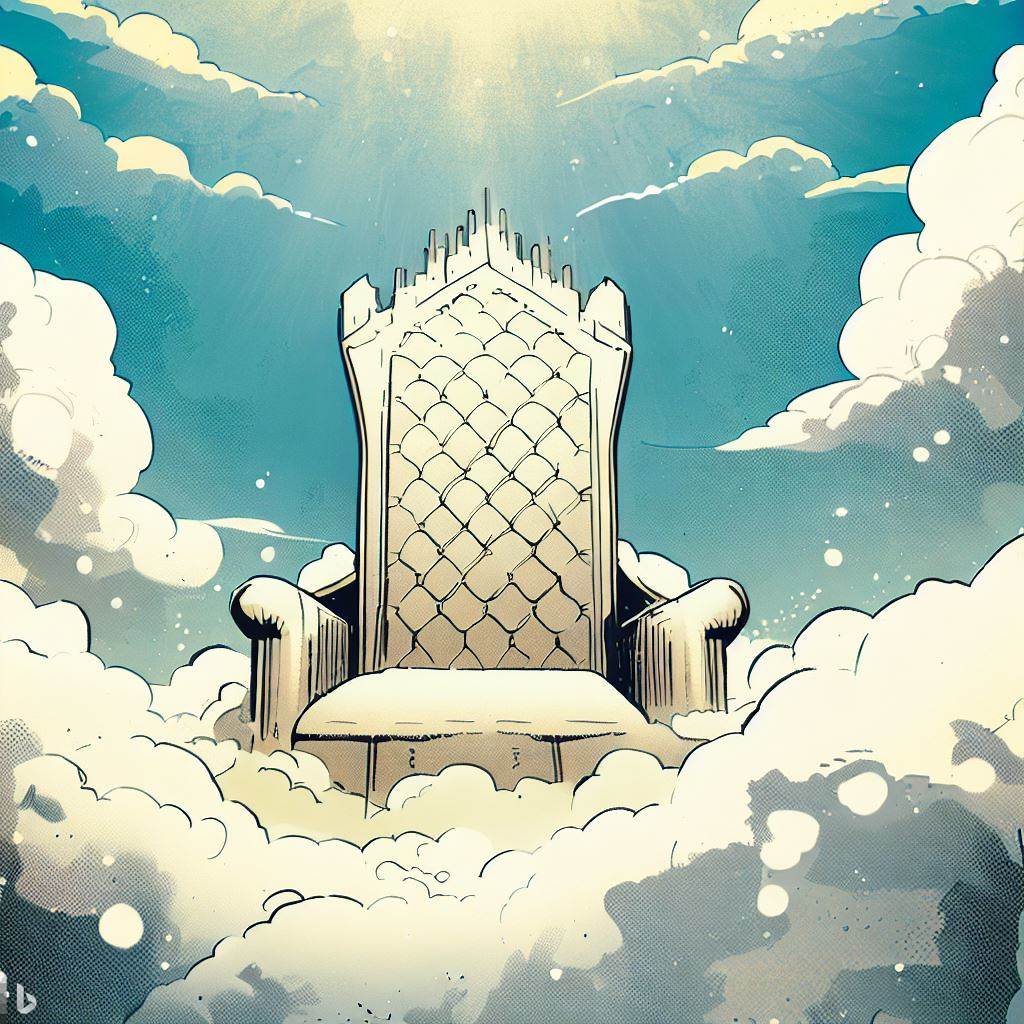
Isa 66:23 And it shall come to pass, that from one new moon to another, and from one sabbath to another, shall all flesh come to worship before me, saith the LORD. Isa 66:24 And they shall go forth, and look upon the carcases of the men that have transgressed against me: for their worm shall not die, neither shall their fire be quenched; and they shall be an abhorring unto all flesh.
During the kingdom, everyone in the world will come to Zion to the Lord to worship before Him whether they believe in Him or not. Verse 24 tells us, And they shall go forth, as they are leaving Mount Zion, they will on every occasion view, as a warning, the carcasses of the men that have transgressed against the Lord. They will, somehow, someway, be able to see all the souls suffering in the place of torment in Sheol.
Notice how he says at the end of verse 24 that they shall be an abhorring unto all flesh. To “abhor” is to detest something. To hate it. People will have an extreme aversion to seeing the suffering souls. They’re an abhorring unto all flesh. They’re not an abhorring to all the resurrected saints, only to the mortals, the people of flesh. The mortals will see this warning for one thousand years, and yet, they will still choose to rebel and try to kill Christ at the end of the Lord’s thousand-year reign.
In fact, seeing the suffering souls may, in their sin-cursed thinking, be part of the reason why they hated Christ and chose to rebel against Him.
Notice also the description of those suffering. Verse 24 says, And they shall go forth, and look upon the carcases of the men that have transgressed against me: for their worm shall not die, neither shall their fire be quenched…
What does it mean that their worm shall not die? I suspect he’s speaking of maggots on a dead body. This is an expression that is illustrative of perpetual suffering. The body never dies, which means the maggots never die. This is a perpetual death.
In Mark 8:46, the Lord also spoke of eternal suffering as the place where the worm dieth not and the fire is not quenched. My friend Bryan Ross once made the point that this may mean that in the second death people are totally abandoned by God to the degenerative effects of sin so much so that they are ultimately reduced to the most basic form of complex life.
All of this sets the stage for the Great White Throne.
The people who stand before God seated upon His Great White Throne are the unbelievers of all ages. They are condemned already for their unbelief and the Great White Throne is essentially their sentencing. This is when God will examine their works and determine degrees of punishment for all eternity in the Lake of Fire.
We know that the Lake of Fire is different than Hell. Hell is simply an intermediate holding place in Sheol or Hades, which is a pit deep inside the earth (Luke 16:19-31) where unsaved souls await final judgment at the Great White Throne after the thousand-year reign of Christ on Earth (Rev. 20:5). By comparing Scripture with Scripture, we know that the Lake of Fire is a place of eternal anguish (2 Thess. 1:8-9). We know it’s a place where souls shall be tormented with fire and brimstone in the presence of the holy angels and in the presence of the Lamb, that the smoke of their torment shall ascend up forever and ever, and they’ll have no rest day or night (Rev. 14:9-11). We know it’s a place of outer darkness (Matt. 8:12). We know it’s a place where the fire is not quenched and the worm dieth not (Mark 9:43-48). We know it’s the place prepared for the devil and his angels (Matt. 25:41). We know that Hell will be cast into it (Rev. 20:14). We know that those who shall be cast into it will lose neither consciousness nor memory (Luke 16:19-31). And we also know that in the Lake of Fire there will be no holiness, no righteousness, no goodness, no love, no light, no peace, no joy, and no hope – only agony and misery and suffering forever and ever.
Rev 20:11 And I saw a great white throne, and him that sat on it, from whose face the earth and the heaven fled away; and there was found no place for them. Rev 20:12 And I saw the dead, small and great, stand before God; and the books were opened: and another book was opened, which is the book of life: and the dead were judged out of those things which were written in the books, according to their works. Rev 20:13 And the sea gave up the dead which were in it; and death and hell delivered up the dead which were in them: and they were judged every man according to their works. Rev 20:14 And death and hell were cast into the lake of fire. This is the second death. Rev 20:15 And whosoever was not found written in the book of life was cast into the lake of fire.
Bullinger, in his book on Revelation, would make the point that the Great White Throne Judgment is the last in a series of 5 judgments going back to chapter 19.
1- In 19:17-21, we have the Judgment of the Beast and the False Prophet.
2- In 20:1-3, we have the Judgment of Satan before the millennium.
3- In 20:4-6, we have the judgment/reward of the overcomers. The “rest of the dead” stay in Sheol awaiting judgment at the Great White Throne.
4- In 20:7-10, we have the Judgment of Satan after the millennium.
5- And here in 20:11-15, we have the Judgment of unbelievers at the Great White Throne.
All of these judgments are earthly. Thus, I’d suggest that because of the context, it may be likely the Great White Throne Judgment will take place upon the Earth.
Question – Paul twice references Isa. 45:23. He wrote in Php 2:10 That at the name of Jesus every knee should bow, of things in heaven, and things in earth, and things under the earth; Php 2:11 And that every tongue should confess that Jesus Christ is Lord, to the glory of God the Father. When does that happen? I would suggest this happens at the Great White Throne. This is the only time all humans who ever lived will be gathered together in one place for one event.
We believers will not be standing before the throne amongst all the unbelievers awaiting judgment, but I believe we will all be there as witnesses. And there will be a moment at this hearing in which every single human who ever lived will all bow their knee, and every single tongue will confess that Jesus Christ is Lord, because clearly He is, as He is sitting upon that Great White Throne. Even though the Great White Throne is not the happiest of occasions, seeing all the souls of all the humans who ever lived and seeing them all bow their knee and confess that Christ is Lord, is a profound moment we will never forget for all eternity.
Exegesis
In Rev 20:11 we read, And I saw a great white throne, and him that sat on it, from whose face the earth and the heaven fled away; and there was found no place for them.
First, a Great White Throne. In what sense is the throne great? We spent some time in this series looking at the throne room of God and His throne. You may recall that John saw a massive throne. Lightning was shooting out of the throne. There was thunder and voices. There was a giant rainbow round about the throne in sight like unto an emerald. There were 24 elders and seven lamps of fire representing the seven Spirits of God.
That was the throne of God the Father.
That throne was never called “great.”
But this Great White Throne, without any lightning shooting out of it or massive rainbows or elders or lamps, this throne is called great. Why? I loved a point Bullinger made. He said, “It is not only ‘great,’ to indicate the greatness of the occasion, and of its power and authority: but ‘white,’ to indicate its purity, holiness, and righteousness.”
This is a great occasion. God has been warning about this since the man’s fall into sin.
Then we’re told about the occupant of this Great White Throne, “him that sat on it, from whose face the earth and the heaven fled away; and there was found no place for them.”
What does that mean? From whose face the earth and the heaven fled away?I suspect this is talking about the intensity of everyone’s focus upon Christ in this moment. Everyone here is so intensely focused upon Him, it’s as if the Earth and Heaven, the sun and the moon, the stars, everything, has fled away. Christ has now taken up the full attention of His entire creation. Nothing exists in their peripheral vision. Christ will so fully occupy the mind’s eye of every soul, it’s as if there is no room for Heaven and Earth anymore. There is only Christ upon His throne.
The massive scale of this moment we cannot possibly comprehend. There is also the implication here that there’s no place to go. No place to hide. They know Christ knows everything. He has records of everything. For unbelievers, I imagine they’ll really feel the weight of Heb. 4:13, which said, all things are naked and opened unto the eyes of him with whom we have to do. They will feel exposed. They will feel naked. Because all their awful works will be revealed and judged by God Himself. And the consequences for those works will mean more suffering for all eternity.
Rev 20:12 And I saw the dead, small and great, stand before God; and the books were opened: and another book was opened, which is the book of life: and the dead were judged out of those things which were written in the books, according to their works.
There’s a lot to say here. The dead here are those who lived not again, those who were not part of the first resurrection at the Lord’s Second Coming. They’re called dead, because they were never quickened or made alive. They’re dead because they lived their whole lives being separated from God’s life and light. They’re dead because they’re cut off from the life of God.
These dead people remained in the place of torment for the thousand years until now. They are brought out of the place of torment to stand before God. John describes them as small and great, the weak and the powerful, the unknown and the known, all those who lived and died in unbelief. They stand before God just as we see people stand before a judge at their sentencing.
Then we have the reference to books. John makes a distinction between the Book of Life and all the other books. We’ve covered the Book of Life a few times in this series. I believe this means that at any point since the beginning of time, if any person came to saving faith in God, their name is written into the Book of Life.
The other books are records of all the works of every single person who ever lived. Everything everyone does is witnessed by angels and recorded in books to potentially be used at the Great White Throne. God knew the hearts and minds of every person who ever lived. He knew who believed and who didn’t. But the works will be used to prove unbelief and for all their sins, which are ultimately transgressions against their Creator, justice must be carried out because God is holy.
Thus, at the Great White Throne, unbelievers will be given degrees of punishment in the Lake of Fire for all their sins. That statement would put me at odds with those who believe people are going to Hell with their sins paid for and forgiven. I’ve been told, “No-no, brother Joel. Works are just works. And works is not sin. The Bible makes a distinction between works and sin.” If we’re talking about the actions of the unsaved, how can their works NOT be sin? “Whatsoever is not of faith is sin” (Rom. 14:23). Doesn’t whatsoever still mean whatsoever? Isn’t Paul saying that anything we, or unbelievers, do that is not in harmony with faith in His Word is sin?
A work is simply an action, according to Webster. A physical exertion. In the Bible, there are good works and there are bad works. Those bad works are sins. For example, Isaiah 59:6 says there are “works of iniquity.” In Rom 13:12 and Eph. 5:11, there are “works of darkness.” What does Paul say in Gal. 5:19? “Now the works of the flesh are… these; Adultery, fornication, uncleanness, lasciviousness, Idolatry, witchcraft, hatred, variance, emulations, wrath, strife, seditions, heresies, Envyings, murders, drunkenness, revellings, and such like…” What else are the works of the flesh but sin? Those are actions people chose to take that satisfies the lusts of their sin-corrupted flesh. The flesh tempts a person to commit adultery, for example. One succumbs to that temptation, and that work of the flesh is a sin.
Do you remember how James described the process of sin? He wrote in James 1:14-15, “But every man is tempted, when he is drawn away of his own lust, and enticed. Then when lust hath conceived, it bringeth forth sin: and sin, when it is finished, bringeth forth death.” He’s saying that when temptation has sparked the lust in our sin-corrupted flesh, that person makes a choice. “Shall I satisfy the lust of the flesh or not?” When the soul gives its consent to satisfy the lust of the flesh, then you carry out that work of the flesh, which is a sin. That work, that action, is sin. And when that sin is finished, when that work of the flesh is done, the consequence is death. By death, we mean the death of our bodies plus the judgment of a spiritual death by God, called the second death (Rev. 20:14), which is the ultimate consequence of sin, an eternal separation from God, unless the penalty for all of our sins has been satisfied by an act of atonement, which only the Lord’s sacrifice can resolve for us.
Thus, at the Great White Throne, unbelievers will be judged according to their works.
What are those works exactly? Those are the works of the flesh. Those are the works of iniquity. Those are the works of darkness. Those are the sins unbelievers committed when they succumbed to the temptations of their flesh and performed those works of the flesh.
And the works of the flesh are always sin.
Paul said to unbelievers in Rom. 2:5, that your “impenitent heart treasurest up unto thyself wrath against the day of wrath and revelation of the righteous judgment of God.”
If sins are already paid for, how can one treasure up wrath against the day of wrath? Paul isn’t simply speaking of damnation for one sin of unbelief. He’s speaking of the accumulation of more wrath and more wrath for every new sin they commit. They are treasuring up unto themselves wrath by doing more sins.
Paul wrote in 1 Thess. 2:16 that they, the Jews, were “Forbidding us to speak to the Gentiles that they might be saved, to fill up their sins alway: for the wrath is come upon them to the uttermost.” How is it that these Jews were filling up their sins alway? How can you fill up something that’s already forgiven? Why would Paul even be speaking of filling up sins in a post-Calvary world, if those sins, as some say, are already forgiven? There’s nothing ambiguous about the point Paul makes here. They are filling up their sins in the sense that their volume of sins and depths of wicked works will bring their souls into contact with the uttermost of God’s wrath.
“To fill up their sins alway,” he writes. Why does Paul say alway? He means that this has consistently been a characteristic of the Jews to resist God and to oppose God in all their evil works. They have a long history of filling up their sins to receive the uttermost of the Lord’s wrath because of their constant opposition to God through wicked works.
Notice how Paul said the wrath is come upon THEM, not Christ. The wrath is for THEIR SINS, the actions they took to obstruct Paul. How can wrath be upon them if Christ took upon Himself all that wrath for their sins? Could it be that Christ’s atoning work of redemption hasn’t been imputed to their souls yet because of their unbelief?
Why is it that God’s wrath is come upon them to the uttermost? Does not the context demand that the uttermost of God’s wrath will be poured out upon those Jews for filling up their sins, for ALL their voluminous works of iniquity? What else are those works but sin? Does this not coincide perfectly with Rom. 2:5, which I mentioned? Your impenitent heart treasurest up unto thyself wrath against the day of wrath and revelation of the righteous judgment of God. They are treasuring up wrath FOR THEMSELVES with each and every new sin they commit.
The Lord Himself said in Matt. 23:14, “Woe unto you, scribes and Pharisees, hypocrites! for ye devour widows’ houses, and for a pretence make long prayer: therefore ye shall receive the greater damnation.” When the scribes and Pharisees devoured widows’ houses, “and for a pretence make long prayer” were those not works of the flesh? And why is it that the Lord is giving them the greater damnation? How can there be a greater damnation for devouring widows’ houses and making for a pretense long prayers? Because He’s judging them according to their works. If all sins are already paid for and forgiven, how can God be just in giving these men a greater damnation? Because these men added to their damnation with these egregiously sinful works.
How about all the times the Lord said “more tolerable?” In Matt. 10:15, the Lord spoke of the cities that would reject His disciples, and they were to shake the dust off their feet. He said, Mat 10:15 Verily I say unto you, It shall be more tolerable for the land of Sodom and Gomorrha in the day of judgment, than for that city. In Matt. 11, He spoke of the unrepentant cities and that it shall be more tolerable for the land of Sodom in the day of judgment, than for thee (Matt. 11:24). Why does He say more tolerable? He’s speaking of degrees of punishment. Why would He even say that if He knew He’d be paying for all those sins and people would be going to hell with all their sins forgiven?
There’s a famous verse in Jeremiah 17:9. We all know this verse. “The heart is deceitful above all things, and desperately wicked: who can know it?” Then, in the next verse, Jeremiah writes, “I the LORD search the heart, I try the reins, even to give every man according to his ways, and according to the fruit of his doings.” God isn’t simply going to judge mankind for all their works of the flesh, but He is also going to judge them for the fruit of those works as well, the impact of those sins on the world, the influence of those sins, which is a terrifying thought. Just imagine God judging someone today for their influence upon thousands of others through social media.
More terrifying still is Isaiah 59. The great prophet is talking about the Second Coming of Christ. He writes in Isa. 59:17-18, “For he put on righteousness as a breastplate, and an helmet of salvation upon his head; and he put on the garments of vengeance for clothing, and was clad with zeal as a cloke. According to their deeds, accordingly he will repay, fury to his adversaries, recompence to his enemies; to the islands he will repay recompence.” What is the Lord going to repay? If every sin is paid for, then what is the Lord going to repay? These are the enemies of His children who worshipped Satan through the antichrist and the image of the beast in his one-world system during the Tribulation, and God’s going to repay them for all their abominable acts, especially for murdering His people. And what is He going to repay them WITH? Mercy? Kindness because He already paid for their sins? No. He is going to repay them with divine justice. Retribution to His enemies. He will wipe them off the Earth using only the power that’s in His glory when He returns at Armageddon, and they will be sent to a place of torment to await their sentence here, now, at the Great White Throne.
Make no mistake. Every wicked deed is a sin. And it is a fearful thing to be a sinner in the hands of an angry God, as Jonathan Edwards once preached, because God will reward you with an eternal consequence for every single work of the flesh done in unbelief – unless you get saved.
Consider Rom. 12:19, “Dearly beloved, avenge not yourselves, but rather give place unto wrath: for it is written, Vengeance is mine; I will repay, saith the Lord.” I will repay, saith the Lord. This is a future event in a post-Calvary verse. If sins were already paid for and forgiven, how is it the Lord will carry out vengeance in the future for a wrong that was done to you? Plus, when the Lord says, “I will repay,” what’s He going to repay them with? Flowers? We know exactly what Paul is talking about here. He’s talking about divine justice for that work of iniquity done against you, which was a sin. How is it that Christ could judge sin (a.k.a. “the works of the flesh”), at the Great White Throne if He has already paid for those sins?
Rev 20:13 And the sea gave up the dead which were in it; and death and hell delivered up the dead which were in them: and they were judged every man according to their works.
We have in this verse two primary areas giving up the dead so the souls may stand in judgment before God. We have the sea and we have hell or hades, which is also called Sheol.
First, the sea. What’s that talking about? How can the sea give up the dead? Most commentaries talk about people who died in the oceans and the oceans are somehow giving up those souls, which makes absolutely no sense. Whether an unbeliever dies on land, in the sea, or in the air, in outer space, it doesn’t matter. That unbelieving soul is still going to hell or hades.
I believe the sea is talking about one of two things. ConsiderRev 20:10 And the devil that deceived them was cast into the lake of fire and brimstone, where the beast and the false prophet are, and shall be tormented day and night for ever and ever. At the Lord’s Second Coming, the beast and the false prophet are cast into the Lake of Fire. We already have souls in the Lake of Fire when the Great White Throne Judgment begins. It may be possible that this reference to a sea is talking about the Lake of Fire giving up the souls that were already in it so every human will stand in judgment before God.
Of course, one is a sea and the other is a lake but both are bodies of water. It may be the Lake of Fire is such a giant body of water, it could also be called a sea.
There’s another possibility. It may be possible that the place of torment in Sheol is also a sea of fire similar to their ultimate destination, the Lake of Fire. But there are no other verses to substantiate the idea that souls are in a sea of fire in the place of torment. So I’m going with the first theory that this is a reference to the Lake of Fire even though it says sea. There are only two locations in this verse that’s giving up the dead. The sea and Hades. That has to be talking about the Lake of Fire and all the souls in that place of torment in Hell.
Rev 20:14 And death and hell were cast into the lake of fire. This is the second death.
We can confidently take this literally. This verse literally means that death and Hades were cast into the Lake of Fire. So Hades or Sheol, the place where the dead went, which included both Abraham’s Bosom and the place of torment, that entire underworld is ripped out of the Earth and thrown into the Lake of Fire.
John declares this to be the second death, the death of death, but I think the second death includes what also happens in the next verse. Look at Rev 20:15 And whosoever was not found written in the book of life was cast into the lake of fire. In the Second Death, we have Sheol being ripped out of the Earth and all the unbelievers who were not found written in the book of life, they are all cast into the Lake of Fire.
So the Second Death is the casting away of death, Hell, and all the unbelievers into the Lake of Fire, and the Second Death is also the result of that casting away – eternal torment while being separated from God.
Bryan Ross also once said, “There is a strong indication in Scripture that the second death is more than just eternal separation from God. • Romans 1:23—sin has a degenerative quality to it… • Job 25:6—man is a worm according to this verse… • Mark 9:45—there is a degenerative process in the second death which burns its recipients down to their base, most fundamental level. • Psalm 22:1, 7-18—what is this passage a prophetic description of? Christ on the cross. • Psalm 22:6—what does the person on this cross call himself as he hangs upon it? A worm. • The indication from the verses is that Jesus Christ suffered the second death in his soul as he hung upon the cross… • This is why God the father turned his back on him. • In the second death people are totally abandoned by God to the degenerative effects of sin. So much so that they are ultimately reduced to the most basic form of complex life. While there is not a loss of consciousness or personal identity there is a loss personal identification in a physical sense.”
Conclusion
All of this inevitably leads us to a common question: How can a loving God send souls to eternal damnation? How can a loving God punish souls for all eternity? I know it can seem harsh that a soul will suffer forever. If we ever find ourselves thinking that God’s eternal punishment somehow seems wrong or extreme, we have to remind ourselves that the problem is not with God. The problem is with us not understanding His righteousness and His holiness. God does not need to change the way He judges unbelievers to conform to our limited points of view, but rather, we need to come around to His perfectly righteous and holy point of view. There are eternal consequence for rejecting our eternal Creator. And by telling ourselves that He’s being unfair, all we’re doing is perverting His holy nature, and perverting His righteous standards so He can meet us in the middle, and God is not going to do that.
He is not going to come to us on our terms. We must come to Him on His terms. He is the Creator of Heaven and Earth. Everything is His. “Behold, all souls are mine,” as He declared in Ezek. 18:4. God has every right to make the rules, and we know His rules are sprung from His perfect, holy, righteous, divine nature. “Shall not the judge of this earth do right?” (Gen. 18:25). Yes, He will – always and without exception.
And every soul is without excuse. Rom. 1:18-32 teaches that every man knows God exists, but they hold the truth in their state of unrighteousness. They possess the truth within themselves. They know, intimately within themselves, that God exists. Not only do they know that God exists, but they also know about His eternal power and Godhead (Rom. 1:20) and they suppress that truth within themselves so they may keep on living in their state of unrighteousness (Rom. 1:18). These truths about God’s existence and His power and Godhead is manifest within every human being (Rom. 1:19).
How is that possible? How is it that unregenerate man could know about God’s existence as well as His eternal power and Godhead? Because God has shown it unto them (Rom. 1:19), which is why everyone is without excuse before the eyes of God and subject to His wrath for their state of unrighteousness (Rom. 1:32). They are each one accountable to God for the things God Himself has revealed to them. Paul said that “the invisible things of him from the creation of the world are clearly seen, being understood by the things that are made, even his eternal power and Godhead; so that they are without excuse” (Rom. 1:20).
Bryan once said that “People will be judged based upon the amount of light they were given. Even the native in the middle of the jungle has been given enough so that they are without excuse.”
Fascinating to me that the witness of creation appeals to man’s spirituality and reason. We know instinctively that all motion has a beginning, that there is no effect without a cause, and that order does not spring from chaos or chance. Every life is born. Every life dies. So from whence came our beginning? We all instinctively know: “In the beginning God created the heaven and the earth” (Gen 1:1). The witness of creation moves us to not only acknowledge the existence of God and His power and His deity but we know that we must also worship our brilliant, all-powerful Creator (Rom. 1:21). But most won’t.
Men know within themselves more truth than they’re willing to accept and to properly respond to that truth. They hold down that truth within themselves. They suppress that truth. They imprison that truth within their hearts to rationalize their decision to carry on in their state of unrighteousness without properly worshipping their one, true Creator. They willfully ignore the truth so they can continue fulfilling the lusts of their flesh.
As a result, God gave them up (vs. 24,26) and gave them over (vs. 28) to their degeneracy. And as I like to say, “Who could blame a doctor for letting a patient go who rejected his counsel, who refused to accept his diagnosis and prescription to cure his illness and who by his own free will chose to go his way to his own self-destruction? No one would blame that doctor. No one would say he’s responsible for his death. How can a doctor force a patient to accept the cure? The true cause of the patient’s death was his rejection of the cure by his own self-willed obstinacy.”
Thus, who could blame God, who allowed mankind in his free will to go his way to his own self-destruction, who made a cure available through the sacrifice of His Son, who now offers that cure as a free gift, and never denies His grace and salvation to anyone who accepts His gift by faith?
 SUPPLY OF GRACE