
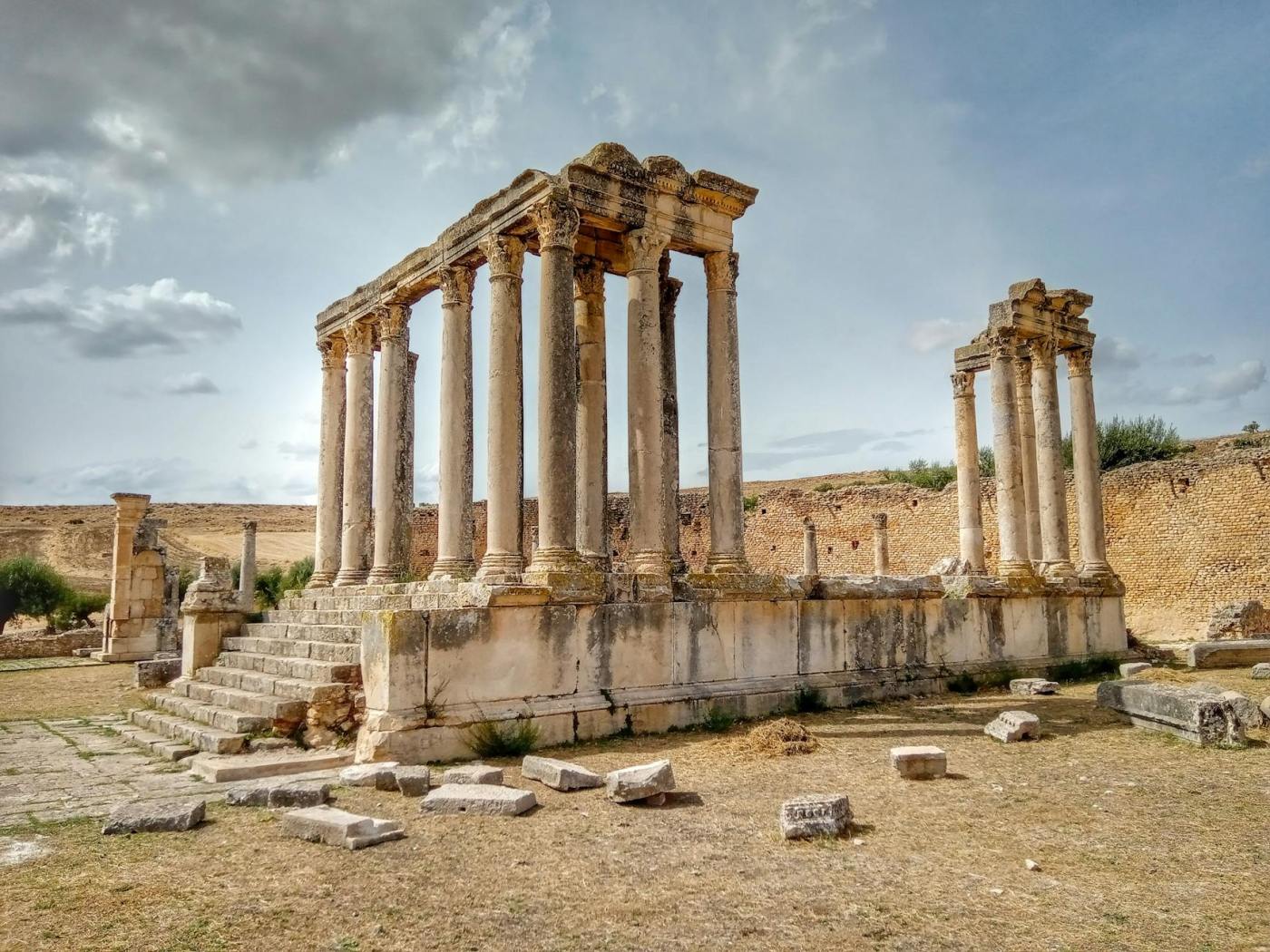
This is a continuation of our series on the Seven Letters to the Seven Churches. We have covered so far the letters to the Jewish churches in Ephesus, Smyrna, and Pergamos.
In the Greek, Thyatira (thai-uh-tee-ruh) was pronounced thoo-at-i-rah. This name sounds unpleasant no matter what language you speak it. Of all the seven letters, this is the longest with a ton of deep, rich content. Of course, it’s famous for the fact that the Lord talks about the depths of Satan. What did He mean by that exactly?
Rev. 2:18-29
Rev 2:18 And unto the angel of the church in Thyatira write; These things saith the Son of God, who hath his eyes like unto a flame of fire, and his feet are like fine brass; Rev 2:19 I know thy works, and charity, and service, and faith, and thy patience, and thy works; and the last to be more than the first. Rev 2:20 Notwithstanding I have a few things against thee, because thou sufferest that woman Jezebel, which calleth herself a prophetess, to teach and to seduce my servants to commit fornication, and to eat things sacrificed unto idols. Rev 2:21 And I gave her space to repent of her fornication; and she repented not. Rev 2:22 Behold, I will cast her into a bed, and them that commit adultery with her into great tribulation, except they repent of their deeds. Rev 2:23 And I will kill her children with death; and all the churches shall know that I am he which searcheth the reins and hearts: and I will give unto every one of you according to your works. Rev 2:24 But unto you I say, and unto the rest in Thyatira, as many as have not this doctrine, and which have not known the depths of Satan, as they speak; I will put upon you none other burden. Rev 2:25 But that which ye have already hold fast till I come. 2:26 And he that overcometh, and keepeth my works unto the end, to him will I give power over the nations: 2:27 And he shall rule them with a rod of iron; as the vessels of a potter shall they be broken to shivers: even as I received of my Father. 2:28 And I will give him the morning star. 2:29 He that hath an ear, let him hear what the Spirit saith unto the churches.
Background
Thyatira meant perfume or sacrifice of labor, and there was a lot of labor in that city. This place was famous for its dyeing facilities (no, not facilities where people died, but facilities where clothes were dyed) and it was famous for purple clothes.
A few years ago, there were articles about how archeologists found in Israel ‘Royal Purple’ Fabric dating to time of King David. If someone was wearing royal purple in ancient days, you knew that person was extremely wealthy, because purple was the most expensive dye. Do you know how they got the purple dye? Very particular murex snails. And they’d get the dye from the snails’ hypobranchial glands, which was unbelievably laborious. You might extract less of a gram of dye per snail, which explains why it was so expensive. Thus, it’d take hundreds and hundreds and hundreds of snails in order for a prince or king to be arrayed in true royal purple, which conveyed to everyone at the time that they were extremely wealthy.
You may also recall that Lydia came from Thyatira. In Acts 16, which was Paul’s first visit to Philippi and which was technically the first time the gospel was preached on European soil, Paul went to a riverside where people liked to pray on Sabbath day. He encountered Lydia. She was a seller of purple from Thyatira. She worshipped God and when she heard Paul, the Lord opened her heart. She was already a believer, but her heart was closed off perhaps because she was discouraged about what happened after Pentecost.
After hearing Paul, she found hope again. Then he baptized her in the river. Of course, all the dispensationalists would ask, “Why did Paul baptize Lydia?” I’d suggest it was because she was already a part of the believing remnant, a member of the Little Flock. Since she was already saved under the kingdom gospel, it was still necessary for her to follow in faith and do the first works of repent and be baptized.
Then she became passionate about helping Paul in his ministry. In fact, she told Paul, “If ye have judged me to be faithful to the Lord, come into my house, and abide there.” Luke said, “she constrained us.” The fact that the Holy Spirit went to the trouble of telling us Lydia’s story, to explain to us that she was already a believer, that she was from Thyatira, and a seller of purple would indicate that she was a seller of the very goods that came out of her hometown. The fact that she was already a believer would seem to be a strong indication that there had to have been a church in Thyatira made up of other believing Jews.
There were some commentaries that tried to make the case that Thyatira and the others had to be future churches because…. wait for it… there was no historical record of the existence of the church in Thyatira. Why do you need records from history to affirm anything in the Bible? Where’s your faith? We pointed out in the intro to this series that in Rev. 1:11, the Lord told John, “What thou seest, write in a book, and send it unto the seven churches which ARE in Asia”, which to me, would mean they existed at the time. John himself was put in charge of distributing the book of Revelation to those seven churches, which means they had to have existed at the time. How was John going to send his book of Revelation to those seven churches 2,000 years after he’s dead, and the world already has God’s completed revelation? Plus, a look at Lydia’s life and the fact that she was a seller of goods from Thyatira and was already believer when Paul met her would seem to be a strong indication that there had to have been a church in Thyatira made up of other believing Jews.
On page 89 of his first Revelation commentary, Paul Sadler, out of the blue, suddenly emphasizes in caps: “THERE WAS NO CHURCH IN EXISTENCE AT THYATIRA AT THAT TIME….”
WHY ARE YOU SCREAMING AT ME ABOUT THE CHURCH IN THYATIRA?
Let’s Do Some Exegesis
Rev 2:18 And unto the angel of the church in Thyatira write; These things saith the Son of God, who hath his eyes like unto a flame of fire, and his feet are like fine brass;
In all the previous letters we covered, the opening of those letters would say something like These things saith he which hath the sharp sword with two edges… These things say the One whose vision you read about in the first chapter. But here, for the first time, the Lord specifically identifies Himself as the Son of God. By calling Himself THE Son of God, the Lord is invoking His deity, His divine authority, His divine power, His divine judgment, all of which are to be feared. He is the eternal Son of God the Father who judges. There’s a common expression I like that “the Son of God became the Son of Man that the sons of men might become the sons of God.”
By saying that He is the Son of God, He is practically interpreting for us why He’s also referencing His eyes like a flame of fire and His feet like fine brass. Because He is the Son of God, He is also the One who has eyes like a flame of fire because He sees everything and judges everything with fire. In Rev. 19:12, His eyes are also a flame of fire when He rides the white horse and comes down to this Earth at His Second Coming because His coming means that His return will bring judgment.
He also highlights His feet as like fine brass. Why were His feet like fine brass? This too speaks of impending judgment. This speaks of when He will tread the wicked under His feet, like we would read about in Isa. 63:3, in which the Lord says, “I have trodden the winepress alone; and of the people there was none with me: for I will tread them in mine anger, and trample them in my fury; and their blood shall be sprinkled upon my garments, and I will stain all my raiment…”
Positives
Rev 2:19 I know thy works… He would say in all His letters to the seven churches.
…and charity… This is the only church in which He’d praise them for being models of charity. I want that to be on the Lord’s list of things He loves about you and your walk!
…and service, and faith, and thy patience… Patience is the calm endurance of afflictions.
…and thy works… Amazing that the Lord would highlight for a second time their works. Why does He do that? I suspect that what’s going on here is that when the Lord first says, I know thy works it’s a broad statement meaning that He knows all their works, good and bad. But when the Lord mentions their works a second time, He means specifically their good works as a result of all the other good qualities He had just listed in this verse. He knows their good works because of their extraordinary charity, service, faith, and patience. That’s amazing.
Finally, He says, and the last to be more than the first. They understood the principle that first shall be last and the last shall be first, which was a common expression by the Lord during His earthly ministry. You may recall the Lord said this after He spoke to the rich, young ruler at the end of Matt. 19. The rich young ruler couldn’t come to grips with the idea of giving up everything to follow Christ. The Lord made the point in Mat 19:30 But many that are first shall be last; and the last shall be first. The most renowned, wealthy figures in Israel at the time will likely hold the lowest positions in the Lord’s earthly kingdom, but the nobodies, the faithful poor who had no problem giving up everything to follow Christ, they will likely hold the greatest positions in the Lord’s earthly kingdom. The first shall be last and the last shall be first.
Concerns
Rev 2:20 Notwithstanding I have a few things against thee, because thou sufferest that woman Jezebel, which calleth herself a prophetess, to teach and to seduce my servants to commit fornication, and to eat things sacrificed unto idols.
First, there was nothing wrong with the idea of a prophetess. There were a number of female prophets in the OT. Isaiah’s wife was a prophet. John the Baptist’s mother, Elizabeth, prophesied when she met Mary, and the babe leaped in her womb. There was also, famously, Miriam (Exo. 15:20), Deborah (Jdg. 4:4), and the Daughters of Philip in Acts 21:9).
My favorite prophetess is Anna in Luk 2:36 And there was one Anna, a prophetess, the daughter of Phanuel, of the tribe of Aser: she was of a great age, and had lived with an husband seven years from her virginity; Luk 2:37 And she was a widow of about fourscore and four years, which departed not from the temple, but served God with fastings and prayers night and day. Luk 2:38 And she coming in that instant gave thanks likewise unto the Lord, and spake of him to all them that looked for redemption in Jerusalem. What an amazing woman! She was one who departed not from the temple Luk_2:37 and served God with fasting and prayer night and day, and in that temple, she spoke of the Lord to all them that looked for redemption in Jerusalem. I love Anna! This woman served God faithfully and trusted in His promise about the soon-to-arrive Messiah about whom she shared with everyone. She rejoiced in His wisdom, His guidance for her life, and she rejoiced in His fulfillment of His promises to Israel. She trusted in His direction for her life. She rejoiced in living the righteous life God would have her to live, and she trusted in the future glory to come promised by God, the deliverance of her soul from all the sorrows of this life with the arrival of her Messiah. She trusted that God would preserve her soul unto His heavenly kingdom here on the Earth.
Anna is perhaps the greatest contrast you can find in the Bible to the prophetess Jezebel mentioned here in Rev. 2. Jezebel means chaste, and this prophetess in Thyatira was anything but. The Lord gave her the designation of Jezebel to illustrate the depths of her wickedness and corrupting influence on Israel at the time. The verse doesn’t say that she called herself Jezebel but only that she called herself a prophetess. Of course, we remember Jezebel from 1 Kings, the wife of Ahab, king of Israel. She is one of the most wicked woman in all of Scripture. She was a Phoenician princess, daughter of Ethbaal, king of the Zidonians. Her husband Ahab was a mere puppet in her hands. 1Ki 21:25 told us that “there was none like unto Ahab, which did sell himself to work wickedness in the sight of the LORD, whom Jezebel his wife stirred up.” She established the worship of Baal on a grand scale in Israel. Baal became the new state sponsored religion. At her table were no less than 450 prophets of Baal and 400 of Eastward. 1 Ki 16:31; 1 Ki 16:21; 1 Ki 18:19. Jezebel cut off the prophets of the Lord (1 Ki 18:4), and slew them, 1 Ki 18:13. Yet there were some good people in hiding that feared God. Prophets read and expounded the law in private meetings while hiding in caves. But the hearts of the people were divided. They worshipped God to please the prophets, but worshipped Baal to please Jezebel and curry her favor. But God would have all or none of their hearts. Elijah would tell them basically that those who are not with God are against him. Elijah would later have the epic showdown with Baal atop Mt. Carmel. Then he went on the run. He became discouraged. The Lord famously told him in 1Ki 19:18 Yet I have left me seven thousand in Israel, all the knees which have not bowed unto Baal, and every mouth which hath not kissed him. Later, Elijah prophesied of Jezebel’s death (1Ki_21:19), which came to pass just as he foretold. In 2 Kings 9, she was thrown out a window. Horses stomped on her. Then she was consumed by dogs.
We have to make distinctions between Jezebel of the OT and the Jezebel in Thyatira at the time. Jezebel in the OT didn’t pretend to be a false prophet like Jezebel in Thyatira. In the OT, Jezebel persecuted saints and made Baal worship Israel’s state religion. But in Thyatira Jezebel wasn’t guilty of forcing people into Baal worship. She was guilty of coercion and subversion. She seduced the Lord’s servants into committing fornication, and eating things sacrificed unto idols.
However, I suspect the Lord gave this false prophetess the designation of Jezebel because of her seemingly endless wickedness and corrupting influence on Israel, because her corrupting influence was on a scale as that of Jezebel from the OT. Some commentaries would make the case that the Jezebel in Thyatira was guilty of subverting the Jews into committing spiritual fornication through idolatry. Now it’s true that the worship of Baal was closely tied to sexual immorality. But if the Jews were guilty of committing idolatry, then why would the Lord complain about eating meats sacrificed unto idols? He would’ve been complaining about the actual worship of Baal itself. I take fornication here literally. He only means literal, sexual immorality. It’s possible that the Jezebel of Thyatira was a false prophet who in secret worshipped Baal, which may have been the reason why she was so intent on subverting the Jews into a lifestyle of fornication, but the Scriptures don’t tell us that. We just have to accept at face value the crimes that the Lord laid out against her. She was guilty of seducing the Lord’s servants into committing fornication, and eating things sacrificed unto idols. That’s it.
Of course, this will not be tolerated by the Lord, nor should this be tolerated by the people of Thyatira. Look again at what the Lord says. Rev 2:20 Notwithstanding I have a few things against thee, because thou sufferest that woman Jezebel, which calleth herself a prophetess, to teach and to seduce my servants to commit fornication, and to eat things sacrificed unto idols. Rev 2:21 And I gave her space to repent of her fornication; and she repented not.
You have to think about this verse. He said, And I gave her space to repent of her fornication. This is really amazing. The Lord has already interacted with Jezebel, and He personally gave her time to repent. I suspect this probably meant that someone filled with the Spirit after Pentecost spoke the words of the Lord to Jezebel directly. She was rebuked for her wickedness and corrupting influence. She was told to stop, or she will face the Lord’s judgment. She was given time to repent, which is to change one’s mind and one’s course, but she refused.
It’s amazing how much that verse speaks of the merciful character of the Lord! Despite her complete wickedness, He rightfully warns her of the judgment to come, which she deserves, and yet at the same time, the Lord also stretched out His hand to her in an offer of peace and reconciliation, which she willfully rejected. That is glorious!
Now Jezebel’s opportunity to get right with God has almost come to an end. Look at vs. Rev 2:22 Behold, I will cast her into a bed, and them that commit adultery with her into great tribulation, except they repent of their deeds. Rev 2:23 And I will kill her children with death; and all the churches shall know that I am he which searcheth the reins and hearts: and I will give unto every one of you according to your works.
Those are fearful verses, and there’s a lot to be said here.
First, He says, Behold, I will cast her into a bed. What did He mean by that? What bed? There is an expression saints in time past used about making your bed, which is an equivalent to us saying that we reap what we sow. Psa_139:8 If I ascend up into heaven, thou art there: if I make my bed in hell, behold, thou art there. In other words, making your bed in hell is reaping what you’ve sown with your life. You’ve made your bed and you’re going to sleep in it. So when the Lord says Behold, I will cast her into a bed, He means that He’s going to punish her in judgment for her works. She’s going to die and she’s going to suffer in Hell. This is a bed of pain, a bed of flames, a bed of anguish and torment in Hell, and those who have sinned with her shall suffer the same fate, but this can be prevented by their quick repentance.
The Lord also says, Rev 2:22 Behold, I will cast her into a bed, and them that commit adultery with her into great tribulation. What does He mean by great tribulation here? I’d suggest that Jezebel and her followers will endure great suffering in Hell. I know some look at this verse, and they see “great tribulation” and they think that He means He’s going to make these people go through what we call “THE great tribulation” and suffer a lot, which must therefore mean that Thyatira must be a future church.
Let’s clarify this expression. We call the second half of the Tribulation “THE great tribulation” but the Lord never called the second half “THE great tribulation”. You will not find “THE great tribulation” anywhere in the Bible, only great tribulation as a descriptive. The Lord had said in the Olivet Discourse in Mat 24:21 that after the Abomination of Desolation, He says, “For then shall be great tribulation, such as was not since the beginning of the world to this time, no, nor ever shall be.” We’ve taken that thought and nicknamed the second half of the Tribulation as “THE Great Tribulation.” I don’t think there’s anything wrong with that. We just have to keep in mind that the Lord never called the second half “THE Great Tribulation.” He merely used “great tribulation” to describe how rough the second half is going to get. “Great tribulation” in the Bible simply means great tribulation, great suffering, great hardships.
We have to consider great tribulation in light of the context. The fact that the Lord talks about death in Rev. 2:23 when He says And I will kill her children with death, I think inevitably forces us to conclude that the description of great tribulation is talking about the great suffering Jezebel and her followers will endure in Hell for their unbelief, their heresy, and wickedness. “Great tribulation” in the Bible simply means great tribulation, great suffering. And when the Lord says And I will kill her children with death, He’s not talking about real children. I think He means all her followers that she begat in her own brand of religious heresy. We know from studies on the age of accountability that not one child will suffer in hell. And in the Bible, children can sometimes mean, children in the faith, or children of the devil, followers of Satan. Remember how Christ told the Pharisees in John 16, “Ye are of your father the devil, and the lusts of your father ye will do.” Satan wasn’t literally their father, but he was spiritually speaking, because Satan was guiding them as a father would a son. On the flipside, the same could be said of us in grace. Remember that in 1 Tim. 1:2 Paul called Timothy my own son in the faith. I think Paul personally led Timothy to Christ on his first apostolic journey. Paul also told the Corinthians they were “begotten” through the gospel. They were reborn into the family of God.
Here’s a question people may have. If you’re saying that these churches existed at the time of the book of Acts, then how God could kill Jezebel and her followers after the age of grace already began? Wasn’t God supposed to now be longsuffering about sin after the age of grace started? God was longsuffering, but not with Israel during the book of Acts. Acts is a transition book. Two programs at the same time. The rise of gentiles vs. the diminishing of Israel. We all know Paul was converted in Acts 9, but you may recall that in Acts 12, God killed Herod because He gave not God the glory. How did He kill him? He smote him with an angel (Acts 12:23).
Why did God kill Herod after the age of grace began? The only logical explanation is that the book of Acts is a transitional book. Two programs at the same time. The rise of gentiles vs. the diminishing of Israel. So if God had the right to kill Herod, which He did because that was a transitionary period, then God also had the right to kill Jezebel and all her followers who existed at the time in Thyatira. But once the book of Acts had concluded, that transitionary period was over. The age of grace had been fully implemented and God was longsuffering with everyone.
Rev 2:22 Behold, I will cast her into a bed, and them that commit adultery with her into great tribulation, except they repent of their deeds. Rev 2:23 And I will kill her children with death; and all the churches shall know that I am he which searcheth the reins and hearts: and I will give unto every one of you according to your works.
His judgment upon Jezebel and all her followers will send shockwaves throughout Israel and all the churches will be reminded that the Lord Jesus Christ is the judge of all mankind who gives to every man according to his works, and He is the One who searches the minds and the hearts of every person on this planet.
When the Lord says I am he which searcheth the reins and hearts, this is a callback to many famous passages. Remember what the Lord told Samuel in 1 Sam. 16:7 …for the LORD seeth not as man seeth; for man looketh on the outward appearance, but the LORD looketh on the heart. Remember how Jeremiah wrote in Jer. 17:9 The heart is deceitful above all things, and desperately wicked: who can know it? In the next verse he writes, Jer. 17:10 I the LORD search the heart, I try the reins, even to give every man according to his ways, and according to the fruit of his doings. And how can you not think of Heb. 4:13 Neither is there any creature that is not manifest in his sight: but all things are naked and opened unto the eyes of him with whom we have to do.
So what’s the principle the Tribulation saints will learn when they’re reading this letter? They’ll learn that what was true for Thyatira at the time is also true for believing remnant in the Tribulation. They will encounter through false prophets and prophetess’s the depths of Satan’s cunning abilities and only the words of Christ will deliver them. If they follow a false prophet like a Jezebel, they will fall out of His divine protection and under His judgment and probably die. They won’t lose their salvation, but they’ll be robbing themselves of great rewards, and great positions, in the kingdom at the Lord’s Second Coming.
Depths of Satan
Rev 2:24 But unto you I say, and unto the rest in Thyatira, as many as have not this doctrine, and which have not known the depths of Satan, as they speak; I will put upon you none other burden. Rev 2:25 But that which ye have already hold fast till I come.
Oh the depths of Satan!
Webster defines depth as “Deepness; the distance or measure of a thing from the surface to the bottom, or to the extreme part downwards or inwards.” Who ever thought of Satan as having any kind of depth? In writing circles, the depth of a character is usually someone who has contradictions in his personality. Mobsters are sometimes viewed as characters who have some depth to them because a mobster is usually a family man and yet, he’s also a killer. That contradiction gives him some depth to his personality. Hamlet is usually viewed as the most complex character ever written, because of his many contradictions in his personality. He seems spiritual until he’s blasphemous. To Ophelia he’s first loving and tender, then callous, even sadistic. He’s courageous, then cowardly. At times he’s cool and cautious, then impulsive and rash. He’s ruthless and compassionate, proud and self-pitying, witty and sad, weary and dynamic, lucid and confused, sane and mad. His is an innocent worldliness, a worldly innocence, a living contradiction of almost every human quality we can imagine. Through that filter, I never viewed Satan as having any depth. In fiction, he’d be viewed as a one-note character because he’s pure evil.
Yet, the Lord speaks here of the depths of Satan, which isn’t depth of character but depth of ability to deceive, evidenced by the example He just gave with Jezebel the false prophet. She was a living example of the depths of Satan’s abilities to deceive.
I loved what Les Feldick had to say about the depths of Satan. He said, “Now stop a minute. What does that mean? For those who had followed Jezebel, who were they really kowtowing to? Satan. And the depths of [him].”
Today, we know that the church with the Holy Spirit is the great restraining force to the mystery of iniquity. Satan practically has both hands tied behind his back, and yet, he has still whipped us good. The church today broadly is in ruins, filled with apostasy, heresy, legalism, doctrines of devils, corrupt Bibles. He’s obfuscated the gospel, blinded men from God’s grace, and kept believers in the dark about who they are in Christ. He’s whipped with both of his hands tied behind his back. When the Tribulation comes, though, Satan will be unrestrained, unhindered in his abilities to deceive and the world will truly witness the depth of his abilities to deceive. There will be demon possession and they’ll be able to perform miracles so convincing they would deceive the very elect. Satan and the demonic realm have had 6,000 years to memorize the Word of God such that they know exactly how to twist His Word that they could convince people of anything, which is why I think the Lord says, the depths of Satan, as they speak. He’s speaking of Satan’s ability to pervert Scripture to convince people to sin. The cleverness of Jezebel to deceive illustrates the depths of Satan’s cunning.
Let’s look at this verse again. Look at Rev 2:24 But unto you I say, and unto the rest in Thyatira, as many as have not this doctrine, and which have not known the depths of Satan, as they speak; I will put upon you none other burden. He’s speaking to those in Thyatira who have not embraced Jezebel’s heresies and have not encountered Satan’s depth of ability to deceive through words. Then He says, I will put upon you none other burden. In other words, you’ve got other spiritual problems, as well, but I’m not going to put you under the burden of judgment now for those other issues except as it relates to Jezebel and all her followers.
Then the Lord says in Rev 2:25 But that which ye have already hold fast till I come. In other words, never let go of the sound kingdom doctrines given to them by the Lord Jesus Christ and all the prophesies.
Reward
Rev 2:26 And he that overcometh, and keepeth my works unto the end (in other words to the believer who is seeking to overcome Satan during the Tribulation, you must keep in mind all my words, meditate upon my words, and understand all that I’ve done and why I did it, and then He says), to him will I give power over the nations: Rev 2:27 And he shall rule them with a rod of iron; as the vessels of a potter shall they be broken to shivers: even as I received of my Father. Rev 2:28 And I will give him the morning star. Rev 2:29 He that hath an ear, let him hear what the Spirit saith unto the churches.
I think it’s a timeless principle in the sense that just as we are rewarded for our quality service to the Lord, so too, all the believers since Adam and Eve will rewarded for their service with positions in the kingdom. The least shall be the greatest. The great, faithful nobodies of time past and great overcomers of the Tribulation will be given high-ranking positions in the kingdom. They’ll be given power over the nations with the ability to discipline them. He said in Rev 2:27 And he shall rule them with a rod of iron; as the vessels of a potter shall they be broken to shivers: even as I received of my Father. This is absolutely stunning. The Lord’s reign and authority over this Earth is given to Him from the Father, and the Lord is going to share His authority over the nations with His own people based on the quality of their service to Him. You talk about gracious. He is actually willing to share His power with His people.
Rev 2:28 And I will give him the morning star.
What does he mean by that? In what sense will he give this man who overcomes the Tribulation and keeps His Word until the end, how will he be given the morning star? I suspect this is a reference to the famous verse of Num 24:17, “I shall see him, but not now: I shall behold him, but not nigh: there shall come a Star out of Jacob, and a Sceptre shall rise out of Israel, and shall smite the corners of Moab, and destroy all the children of Sheth.” The rising star out of Jacob is the Lord Jesus Christ Himself who will have dominion over the nations. The context here defines the morning star. This overcomer given the morning star is one who will be part of the rising star out of Jacob who shall be given a position over those nations with God’s marching orders of ruling over them with a rod of iron with the ability to break them as pottery broken to pieces. And we know this person will be in his glorified resurrected body, freed from sin, filled with the Spirit, and he or she will rule over the nations as righteously as Christ Himself. For a Jew, this is a position in the kingdom so glorious, you almost want to go through the Tribulation just to be able to get that job.
Almost.
 SUPPLY OF GRACE
Leave a comment