
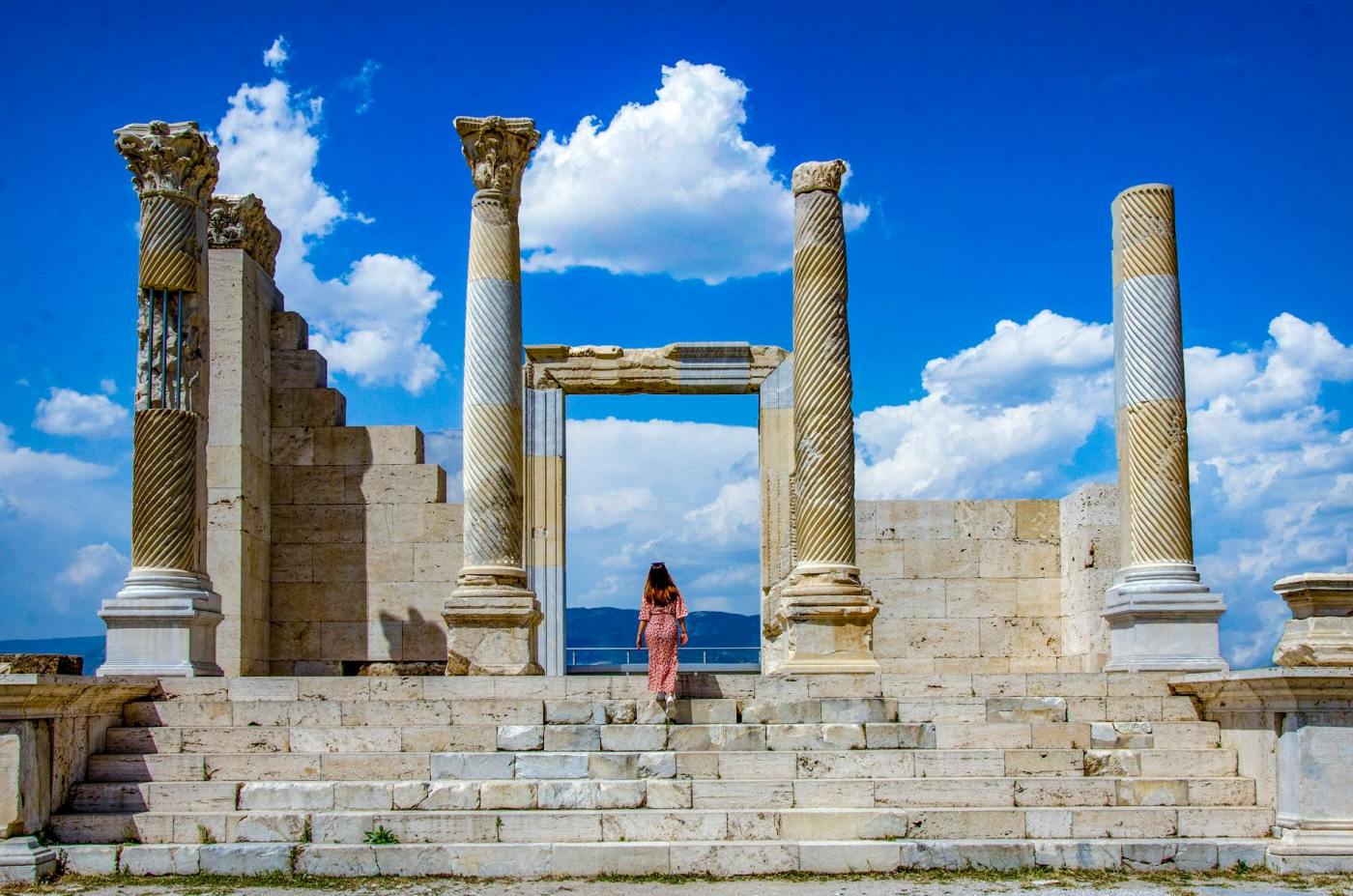
Today, we’re concluding our look at the seven letters to the seven churches with the letter to Laodicea. I love this letter. The Lord has nothing good to say to these people. This is the famous lukewarm church, neither hot nor cold.
It’s interesting to me that just as Paul’s final letter, 2 Tim., presents a portrait of a church in ruins, so too, this collection of seven letters to seven Jewish churches ends tragically. It ends with a portrait of a church in ruins, well, spiritual ruins even though they were probably the wealthiest of all the churches in the group.
Fun fact. Archeologists recently unearthed a hymn book in Laodicea. This Laodicean church had their own hymn book. Some of the titles include:
- A Comfy Mattress Is Our God,
- Above Average Is Thy Faithfulness,
- Amazing Grass, How Sweet the House,
- Be Thou My Hobby,
- Blest Be the Tie That Doesn’t Cramp My Style,
- (Instead of Count Your Blessings) Count Your Money,
- Go Tell it on the Speed Bump,
- Lord, How Kinda Good Thou Art,
- I Surrender Little,
- Just as I Am, with Lots of Excuses,
- My Hope Is Built on Nothing Much,
- O Come, All Ye Wishy Washy,
- Oh, How I Kinda Sorta Like Jesus,
- Onward, Christian Girl Scouts,
- Pillow of Ages, Fluffed for Me,
- Sit Up, Sit up for Jesus,
- Surely Goodness and Money,
- What an Acquaintance We Have in Jesus,
- When Peace, like a Trickle, and…
- When the Saints Go Wandering In (By Mistake).
The Letter to Laodicea
Rev 3:14 And unto the angel of the church of the Laodiceans write; These things saith the Amen, the faithful and true witness, the beginning of the creation of God; Rev 3:15 I know thy works, that thou art neither cold nor hot: I would thou wert cold or hot. Rev 3:16 So then because thou art lukewarm, and neither cold nor hot, I will spue thee out of my mouth. Rev 3:17 Because thou sayest, I am rich, and increased with goods, and have need of nothing; and knowest not that thou art wretched, and miserable, and poor, and blind, and naked: Rev 3:18 I counsel thee to buy of me gold tried in the fire, that thou mayest be rich; and white raiment, that thou mayest be clothed, and that the shame of thy nakedness do not appear; and anoint thine eyes with eyesalve, that thou mayest see. Rev 3:19 As many as I love, I rebuke and chasten: be zealous therefore, and repent. Rev 3:20 Behold, I stand at the door, and knock: if any man hear my voice, and open the door, I will come in to him, and will sup with him, and he with me. Rev 3:21 To him that overcometh will I grant to sit with me in my throne, even as I also overcame, and am set down with my Father in his throne. Rev 3:22 He that hath an ear, let him hear what the Spirit saith unto the churches.
Laodicea
Laodicea is part of a tri-city region that includes Colosse, Laodicea, and Hierapolis. They’re less than 10 miles apart. Laodicea was the wealthiest and the greatest of those 3 cities and was known for it’s manufacturing of clothing and its school of medicine.
Do you know what they are famous for developing? Eye drops. They mixed water with this powder made from ground Phrygian stone. They put it in a collyrium and – voila! – you had eye drops. In Rev. 3:18, the Lord actually references the eye drops. He says, “and anoint thine eyes with eyesalve, that thou mayest see.” The word “eyesalve” isn’t mentioned anywhere else in the Bible. And I suspect the Lord was referencing the very eye drops that were developed in Laodicea, and He brilliantly used that to make a point about their spiritual blindness.
Consider that in Col. 4 Paul mentions THE church of the Laodiceans.
Col 4:16 And when this epistle is read among you, cause that it be read also in the church of the Laodiceans; and that ye likewise read the epistle from Laodicea. Col 4:17 And say to Archippus, Take heed to the ministry which thou hast received in the Lord, that thou fulfil it.
I’m most familiar with Laodicea because of the obsession I once had for Paul’s letter to Philemon. All the books said that Philemon lived in Colossae. There’s no way. Archippus is referenced at the beginning of Philemon. He was generally thought to be the pastor of the church in Laodicea. And he’s also referenced here. Paul gives instructions to these men to go to Laodicea. In vs. 16, he says he wants them to go to THE church of the Laodiceans. There is only ONE church in Laodicea. He wants them to go to that one church. He wants the Colossian epistle to be read in that one church. And he wants those men to read the epistle to the Laodiceans.
And then what does he say? In vs. 17, he says, “AND say to Archippus, Take heed to the ministry which thou hast received in the Lord, that thou fulfil it.” Where is Archippus located? He has to be in Laodicea. Paul’s saying “Go to Laodicea. Share this Colossian epistle. Read their epistle. AND while you’re there, give this message to Archippus.” He had to be in Laodicea.
This means that Paul’s not talking about a Jewish church filled with members of the Little Flock. He’s talking about a grace church, and that has to be the church in Philemon’s house. If Archippus lived in Laodicea, then so must Philemon, Apphia, and the church that’s in Philemon’s house. If there’s only ONE church in Laodicea, then that church can ONLY be the one that’s in Philemon’s house. Which means that that reference to the “epistle from Laodicea” had to be, nothing less than, Paul’s letter to Philemon.
Which brings about an interesting question. How do you explain the Laodicean church in Revelation? If Paul says THE church in Laodicea and that was a grace church, then how do you explain the letter to Laodicea in Rev. 3? Two reasons.
1) I suspect Paul meant the one grace church. The church in Revelation existed at that time but that was a church made up of lukewarm members of the Little Flock. Paul wasn’t ministering to them. Different church. Different program. He promised Peter and the others in Gal. 2 that he’d confine his ministry to the heathen whereas Peter and the twelve would minister to the Little Flock.
2) In that letter in Revelation, Christ had rejected that church for their indifference to Him. He tells them, I will spue thee out of my mouth. They were a rejected church. Cast out. He had already passed judgment upon them. They were on the outs with the Lord.
Epic Exegesis
Let’s start with some exegesis on these passages. Rev 3:14 And unto the angel of the church of the Laodiceans write; These things saith the Amen, the faithful and true witness, the beginning of the creation of God. What a phenomenal, moving, piece of writing about the Lord. He’s described as three things here. He’s THE Amen. He’s THE faithful and true witness, and He’s THE beginning of the creation of God.
So, first, the Amen. Paul Sadler wrote in his Revelation commentaries: “He is called the Amen because, through Him, the purposes of God are established…” The word, Amen, is a word that affirms something. I agree. The word also carries with it the ideas of trust, confidence, firmness, and stability. Here, the Lord is THE Amen. He is the living affirmation of the will and glory of God the Father. In Christ, we have trust, confidence, firmness, and stability.
How can you not think of 2Co 1:18? But as God is true, our word toward you was not yea and nay. 2Co 1:19 For the Son of God, Jesus Christ, who was preached among you by us, even by me and Silvanus and Timotheus, was not yea and nay, but in him was yea. 2Co 1:20 For all the promises of God in him are yea, and in him Amen, unto the glory of God by us. Did you notice the Amen is capitalized? Amen in the Bible is always capitalized perhaps because Christ is THE Amen. Amen is an affirmation of your confidence and trust in Christ, who is THE Amen, to whom you are praying.
He says, But as God is true, our word toward you was not yea and nay. As God is true, God’s Word to us is true. It’s not something about which we can be indecisive, that it’s yea and nay. The truth is not up for debate. It is only yea. It is only infallible truth. The promises of God in Christ are not yea and nay, but only yea and Amen. There is an unbroken constancy and unquestionable sincerity and certainty in all the parts of the Word of God.
If the truth of God is unwavering, then we should also be unwavering about His truth.
Paul said in vs. 20, “For all the promises of God in him are yea, and in him Amen, unto the glory of God by us.” The truth of God the Father, in the person of Christ, and the operation of the Spirit, all work together to ensure that His promises are guaranteed to everyone who believes, and the accomplishment of the fulfillment of all His promises shall be to the glory of God by us. We glorify the Father not only by affirming His truths, by demonstrating that His life is manifest in us, but also in the ages to come the Father will shew the exceeding riches of his grace in his kindness toward us through Christ Jesus (Eph. 2:7). In the coming ages and for all eternity, God is going to put on display His glory, display the exceeding riches of His grace, through and in His masterwork, which is us. When everything in the universe sees the billions of glorified saints in their glorified seats, they are going to marvel at the exceeding grace of God the Father. So just as Christ is THE Amen, the true and faithful witness, the One who affirmed with His life the will of His Father, He was the instrument of the glory of the Father, so too, we are instruments of the glory of the Father and the Son.
Second, we read of Christ that He is the faithful and true witness, which is a callback to what was said of Christ in Rev 1:5 And from Jesus Christ, who is the faithful witness, and the first begotten of the dead, and the prince of the kings of the earth. Unto him that loved us, and washed us from our sins in his own blood. He is the faithful witness. He is the faithful and true witness. And it’s certainly true that He is faithful in His promises to the kingdom saints. He is also faithful in all of His promises to us. And He will be faithful to His Word about unbelievers and all the judgment that’ll befall them.
But I think faithful and true witness runs deeper than that.
As He is of the Father, He and the Father are one, so too, He is the faithful witness, the abiding stable witness of His Father in Heaven. His faithfulness to the will of the Father during His earthly ministry was the perfect testimony to all of us of who Christ is and also the glorious will, the love, the grace, and the wisdom of the Father. He is the faithful and true witness. No one else can compare to Christ in terms of fidelity to the Father’s will, and no one else can compare to Christ in terms of the perfect testimony.
Next, we read in Rev 3:14 that He’s the beginning of the creation of God. What is He talking about here? Does He mean that He was the first created being of the Father? I don’t think so. I suspect that He’s the beginning of the creation of God in the sense that He caused the universe to exist, that is, He was the author of all things, which also means that He holds the preeminence over the entire creation. Notice also how this verse says the beginning of the creation of God.Whose creation is this? Is this the Father’s creation or the Son’s? YES. The three operate as one. All things are of the Father, by Jesus Christ, through the Spirit.
Rev 3:15 I know thy works, that thou art neither cold nor hot: I would thou wert cold or hot. Rev 3:16 So then because thou art lukewarm, and neither cold nor hot, I will spue thee out of my mouth.
Here we arrive at the great concern the Lord had about this Jewish church. They’re lukewarm. They’re moderately warm; tepid. Lukewarm can also mean not ardent, not zealous, cool, indifferent, as lukewarm obedience, or lukewarm patriots. Or a lukewarm church. Lukewarm is keeping up appearances without any real convictions of faith. Valerie made the point on a podcast yesterday that lukewarm water is often unclear, whereas hot or cold water is perfectly clear. Sadler would say that lukewarm sounds an uncertain trumpet. I would argue that lukewarm churches are most susceptible to heresies. Why should people care about Christ if you don’t?
The Lord tells them that He’d prefer them to take a stand of some kind. I would thou wert cold or hot. If faith is worthy anything, then it is worth everything and being lukewarm in matters of faith is spiritual lifelessness, which makes you susceptible to indulging the flesh. And what we have in this church are lukewarm sermons for lukewarm people, no spiritual life, no spiritual conviction about anything, all about appearances and lip-service and no faith, because they think they already have everything they need. They think their wealth will provide them what they lack spiritually, when, ironically, they don’t even see the value in the spiritual riches they’re missing. They were poor when they thought they were rich.
Plus, it is an offence to God to be on the fence about His Son. Or to use Him only for the sake of keeping up appearances. The Lord can’t work with that. Be a man. Do something. Take some kind of stand.
But they won’t, and the Lord tells them, I will spue thee out of my mouth. The idea is, that they would be rejected, cast off as a church. You’ve tasted something and you’re spitting it out. You’re rejecting it. This, again, is not a loss of salvation for those who are believers. This is a guarantee of judgment coming on the Earth. He’s going to carry out judgment on them to chastise them out of love, so they will wake up and live for the Lord. Bullinger points out that this kind of expression about spuing them out of His mouth when used in the OT usually had to do with their land. Lack of faith could mean expulsion from the land. Lev 18:25 And the land is defiled: therefore I do visit the iniquity thereof upon it, and the land itself vomiteth out her inhabitants…
I think it’s possible that this particular judgment upon Laodicea was carried out when Paul was in prison. Do you know what happened in Laodicea in 60 A.D.? Laodicea had a massive earthquake that leveled the entire city. This mega-disaster had the entire Roman Empire talking. And Rome itself sent word to the Loadiceans that they’d be willing to send men, money, and resources to help rebuild their city. And do you what they said? They told Rome, “No. You can keep your men. We’re going to rebuild our city, thank you very much.” And that’s exactly what they did! Even Tacitus, considered to be a Roman Senator, wrote in his book called “Annals,” that “One of the most famous cities of Asia, Laodicea, was in the same year overthrown by an earthquake and without any relief from us recovered itself by its own resources.”
This is why Paul, in Col. 4, had the men to go Archippus in Laodicea with that message “Take heed to the ministry which thou hast received in the Lord, that thou fulfil it”? Colossians was written after that massive earthquake in Laodicea. Archippus was in Laodicea. And he was devastated by that earthquake! In fact, he was so devastated he couldn’t function! He lost people he loved! Archippus, a fellowsoldier, was a broken man! And what does Paul tell him? He told Archippus exactly what he needed to hear. Take heed to the ministry which thou hast received in the Lord, that thou fulfil it. He talks to him like a solider. You get back on your feet! You go out there and win that war! That was tough love, but I think those were the words he needed to hear. Ministry is never so important as it is in the wake of a giant disaster. And now I can’t help but wonder if that earthquake was God literally spewing out of His mouth the Laodicean church as He had foretold. That is pure Joel-ology.
Rev 3:17 Because thou sayest, I am rich, and increased with goods, and have need of nothing; and knowest not that thou art wretched, and miserable, and poor, and blind, and naked:
They were wretched because of their lack of a spiritual life, miserable because true joy does not come from wealth, poor because they’ve gained nothing from their indifference to God, blind because they’re ignorant of His Word, and naked because they’re not clothed with His righteousness. Their weak satisfaction in life was wrapped up in their wealth. They couldn’t see past their physical lives to consider the unquantifiable value of a truly spiritual life. We have the Lord forcing these people to face the lies in their own delusions vs. the reality of a truly joyous spiritual life in Christ.
Rev 3:18 I counsel thee to buy of me gold tried in the fire, that thou mayest be rich; and white raiment, that thou mayest be clothed, and that the shame of thy nakedness do not appear; and anoint thine eyes with eyesalve, that thou mayest see.
First, there are two items He counsels them to buy from Him: gold tried in the fire and white raiment. So we’ll begin with gold tried in the fire, that thou mayest be rich. All the books had different theories about this gold tried by fire. Many connected this to verses like, 1Pe 1:7 That the trial of your faith, being much more precious than of gold that perisheth, though it be tried with fire, might be found unto praise and honour and glory at the appearing of Jesus Christ. There are many OT verses along this similar line. And they would make the case that these saints should expend their resources to go through the Lord’s trial by fire in order to refine their faith, to grow wise in their faith, and the result would be that they’d become rich because they would have become personally enriched having gone through those trials by fire.
The problem for me with that theory is how do you buy of the Lord to go through a trial by fire? Wouldn’t you go through trials whether you bought it or not? That makes no sense. Not only that, the Lord doesn’t talk about buying from Him the opportunity to go through a trial by fire to become rich.
The Lord talks about buying from Him gold that had already been tried in the fire. He says, I counsel thee to buy of me gold tried in the fire. That gold has already been purified. So what’s the gold? For me, the only theory that makes sense is that He’s referring to the Word itself. It’s not that they had to pay to read His Word, but it’s “buy of me” in the sense of, expend your time and resources to gain from Me that which is of infinite value, that is, to know His Word, which is to know Christ Himself in all His holiness.
You can’t help but think of Psa 12:6 The words of the LORD are pure words: as silver tried in a furnace of earth, purified seven times. How is it that the words of the Lord are purified seven times? Could it be that the Holy Spirit is 7 in 1, that the words of the Lord were tried by all seven Spirits of the one Holy Spirit who authored the very Holy Scriptures we read? I just throw that out there, too.
What would the result be if they expended their resources into knowing Christ through His Word? He says, that thou mayest be rich, spiritually rich, full of wisdom, having an intimate relationship with their Messiah. How can you not think of Paul here and Php 3:7 But what things were gain to me, those I counted loss for Christ. Php 3:8 Yea doubtless, and I count all things but loss for the excellency of the knowledge of Christ Jesus my Lord: for whom I have suffered the loss of all things, and do count them but dung, that I may win Christ. For Paul, the excellency of the knowledge of Christ Jesus, in and of itself, outweighed the value of everything else in life. All the earthly treasures Paul had gained as a Pharisee, he cast them all aside for the heavenly treasure of the excellency of the knowledge of Christ Jesus my Lord. He had seen Christ. He had experienced Christ. He had learned from Christ, and he wanted more. He would desire nothing else. And the excellency of the knowledge of Christ Jesus made it a joy to suffer the loss of all things and count them as dung. He viewed all his former advantages as dung and he viewed his sufferings as nothing, because the gain of the excellency of the knowledge of Christ outweighed everything in life.
Then we arrive at the second item the Lord counseled these Laodiceans to buy of Him: white raiment, that thou mayest be clothed, and that the shame of thy nakedness do not appear… And, of course, the white raiment goes back to what was said to sinful Sardis. Rev 3:5 He that overcometh, the same shall be clothed in white raiment… When we get saved, we become new creatures. When the kingdom saints get saved, they are taken out of the filthy rags of their own sins and self-righteousness, and the Lord clothes them with His own white robes of His righteousness. Now that’s a positional truth, but this is also true in the sense of a practical walk. If they’re living a sinful lifestyle, if they’re indifferent to Christ, lukewarm, on the fence as believers, they’re still defiling their garments. But if they will walk with the Lord in obedience to His Word, they’re walking in pure white because they are in a practical sense adorning themselves in His righteousness. Being pure positionally and practically would have them adorning His white raiment.
Then, the Lord says, and anoint thine eyes with eyesalve, that thou mayest see, which I think is a reference to the eye drops that were developed in that city and He uses that as an illustration. They were spiritually blind but anointing with eyesalve, opening their eyes to Christ, and the joy of a spiritual life through His Word, they’ll be able to see. I was blind but now I see.
Rev 3:19 As many as I love, I rebuke and chasten: be zealous therefore, and repent.
For us, He rebukes through His word, not circumstances, but for Israel in time past, they were rebuked verbally through His prophets, and He would impute their trespasses unto them. He’d charge them for their sin, and carry out judgments upon them on the Earth as a form of chastisement. But that’s not how God operates today. Paul told us in 2 Cor. 5:19 that God is not imputing our trespasses unto us. He’s not charging us for our sins by carrying out judgments on us on the Earth. Why? Because Christ died for those sins. Why should He punish us for sins when He’s already punished His Son? How can it be grace if God’s giving you flat tires because you didn’t tithe? I remember Steve Ross once said, if you get a flat tire, that doesn’t mean God’s punishing you. It means you need to get AAA.
Here’s a question. The Lord tells them to repent. He says in As many as I love, I rebuke and chasten: be zealous therefore, and repent, which doesn’t mean that they have to be sorry for their sins. It meant change their minds, change the course of their lives to serve Christ. So He tells them to repent and yet, in Rev 3:16 He said, So then because thou art lukewarm, and neither cold nor hot, I WILL spue thee out of my mouth. Why repent if the judgment has already been passed? If they repent, He’ll repent. The first one to ever repent in the Bible is God Himself. He repented. He changed His mind of the evil which he thought to do unto his people (Exod. 32:14). Evil in that context was judgment. So by telling them to repent, there was still hope they’d avoid judgment. Think of Jonah. Nineveh. He had passed judgment upon Nineveh, but He willingly repented of that judgment. Why? Because the city of Nineveh repented, which ticked Jonah off, which is why he ran away in the first place, because he knew how gracious God would be. He didn’t want them to get a stay on their execution. He wanted them gone. In the last chapter, Jonah 4:2, he’d yell at God for being gracious. He said, “I fled before unto Tarshish: for I knew that thou art a gracious God, and merciful, slow to anger, and of great kindness, and repentest thee of the evil.” Hilarious. But the big point is that God would repent of His judgment if the people would repent of their sin, because he is a God of grace.
Rev 3:20 Behold, I stand at the door, and knock: if any man hear my voice, and open the door, I will come in to him, and will sup with him, and he with me.
One writer made the point that when John introduces the seven churches in Asia, the Son of Man is standing in the midst of them, but by the time we come to the church at Laodicea the Lord is standing outside the door of this assembly (Rev. 3:20). This verse is often used by pastors in Christendom to say, “God’s knocking on the door of your life! Will you let Him in?” But the real spiritual meaning here is a kingdom principle about them watching for His Second Coming. Are they following carefully His Word? Do they know about His return? When He returns will they be ready for Him?
Look at Luk 12:35 Let your loins be girded about, and your lights burning; Luk 12:36 And ye yourselves like unto men that wait for their lord, when he will return from the wedding; that when he cometh and knocketh, they may open unto him immediately. Luk 12:37 Blessed are those servants, whom the lord when he cometh shall find watching: verily I say unto you, that he shall gird himself, and make them to sit down to meat, and will come forth and serve them. Luk 12:38 And if he shall come in the second watch, or come in the third watch, and find them so, blessed are those servants. Bullinger wrote, “The servants are exhorted to be like unto men that wait for their Lord when he shall return from the wedding; that when he cometh and knocketh they may open to him immediately. Blessed are those servants whom the Lord when he cometh shall find watching…” The wedding here, I think, is a reference back to the parable of the wedding feast, because in Mat 22:2, The kingdom of heaven is like unto a certain king, which made a marriage for his son. But back to Bullinger. He’d also point out, and rightly so, that James 5:9 spoke of the judge who standeth at the door. The Messiah, when He returns, will come looking for them. And He will stand outside their door ready to judge their works in His absence. Bullinger would write that “The nearness of the Lord as the ‘judge’ is the warning conveyed by these words in the Epistle to the Assembly in Laodicea, and not the nearness of the Saviour in grace, or an invitation to sinners in this day of grace.”
He isn’t knocking on their door just to become friends. He’s knocking on that door to judge them for their works, to reward them for their works and then have a literal one-on-one relationship with all of His faithful servants in His kingdom here on Earth. So the believing remnant watching for the Lord is about being obedient to His Word while He’s gone because they know He’s coming back, and the Lord wants them ready to open their doors to Him, prepared for His return, standing confident before Him because of their fidelity to all His instructions and then begins their close relationship with Him in the kingdom.
Rev 3:21 To him that overcometh will I grant to sit with me in my throne, even as I also overcame, and am set down with my Father in his throne. Rev 3:22 He that hath an ear, let him hear what the Spirit saith unto the churches.
How can you not be absolutely blown away by this amazing reward? To him that overcometh will I grant to sit with me in my throne… Who are the overcomers? Tribulation saints who overcome the world by having faith in Christ plus they will overcome Satan during the Tribulation by faithfully obeying the Lord all the way to the end, whether it’s the end of the Tribulation or the end of their lives. Because of their faith in Christ, they have already overcome everything because they have eternal life, and by being faithful to His Word, they will defeat Satan during the Tribulation even if they’re killed. And here, the Lord offers a reward to overcomers that He could allow them sit with Him in my throne.
What did He mean by that?
When He said sit with me in my throne does that mean He has a super-wide throne upon which some overcomers will sit right beside Him? I think they’ll be seated at His right hand. Notice carefully how the Lord says this. To him that overcometh will I grant to sit with me in my throne, even as I also overcame, and am set down with my Father in his throne. Where is He seated? He’s seated at the Father’s right hand, isn’t he?
Here, the exaltation the Father gave the Lord after His resurrection in which He was seated at His right hand is given to illustrate that the Lord will exalt the overcomers to likewise be seated at His right hand in the kingdom. I suspect that sit with me in my throne is an expression about obtaining a high position in His kingdom in which they would be in His presence in His throne room at His right hand during the kingdom.
It’s absolutely jaw-dropping to me that the Lord offers this comparison between Himself, who was obedient unto death, who overcome sin and death in His sacrifice on the cross and became exalted by the Father to be seated at His right hand, and He compares that to the Lord taking these believing saints who overcame sin and death through faith in His name and overcame the tribulation through obedience to His Word, and He would exalt each one of them to be likewise seated at His right hand in the kingdom!
Many commentaries make the point that we see the fulfillment of this promise in Rev 20:4 in which John wrote, “And I saw thrones, and they sat upon them, and judgment was given unto them: and I saw the souls of them that were beheaded for the witness of Jesus, and for the word of God, and which had not worshipped the beast, neither his image, neither had received his mark upon their foreheads, or in their hands; and they lived and reigned with Christ a thousand years.”
 SUPPLY OF GRACE
Leave a comment