
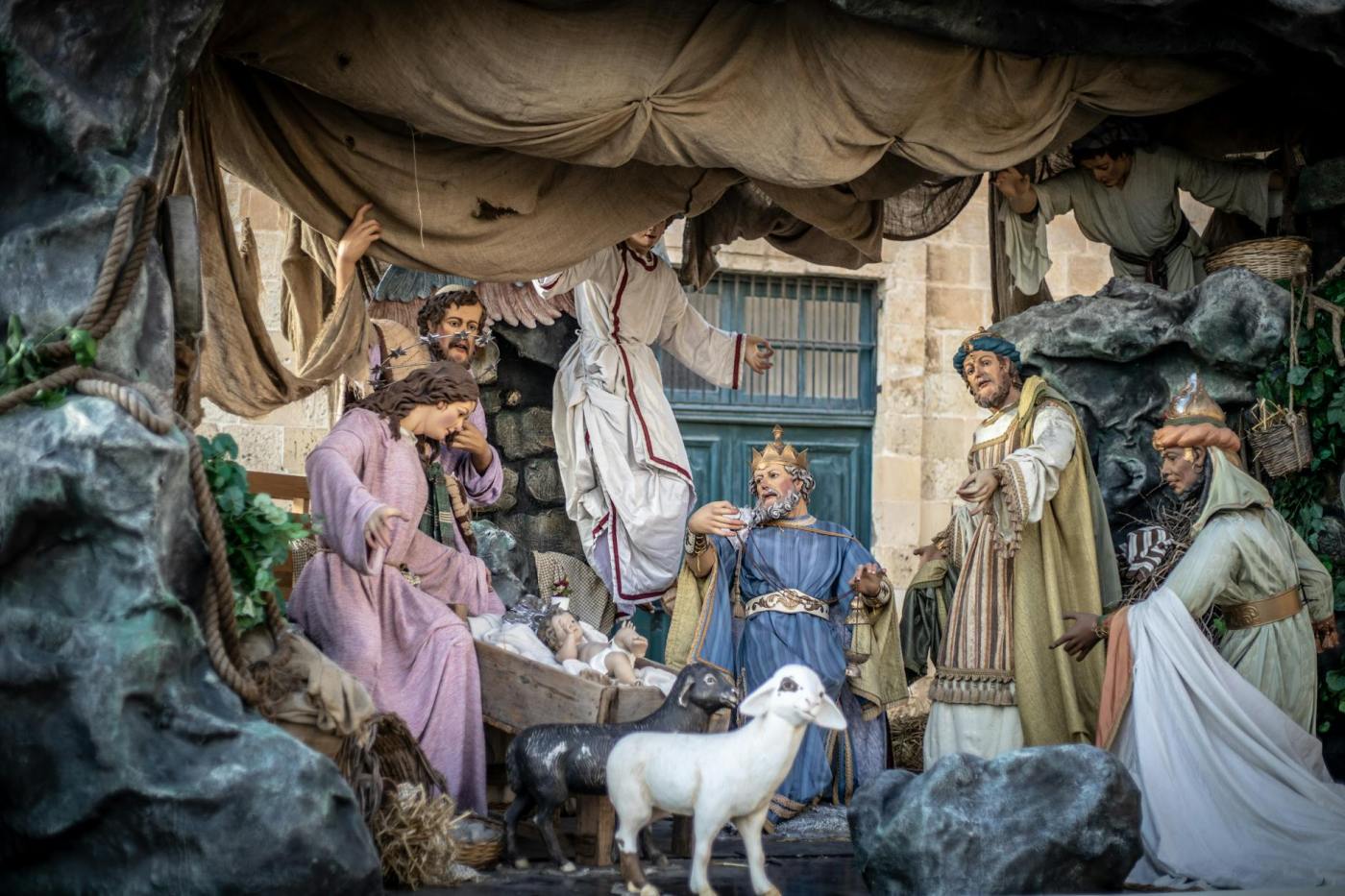
Mat 2:1 Now when Jesus was born in Bethlehem of Judaea in the days of Herod the king, behold, there came wise men from the east to Jerusalem, Mat 2:2 Saying, Where is he that is born King of the Jews? for we have seen his star in the east, and are come to worship him. Mat 2:3 When Herod the king had heard these things, he was troubled, and all Jerusalem with him. Mat 2:4 And when he had gathered all the chief priests and scribes of the people together, he demanded of them where Christ should be born. Mat 2:5 And they said unto him, In Bethlehem of Judaea: for thus it is written by the prophet, Mat 2:6 And thou Bethlehem, in the land of Juda, art not the least among the princes of Juda: for out of thee shall come a Governor, that shall rule my people Israel. Mat 2:7 Then Herod, when he had privily called the wise men, enquired of them diligently what time the star appeared. Mat 2:8 And he sent them to Bethlehem, and said, Go and search diligently for the young child; and when ye have found him, bring me word again, that I may come and worship him also. Mat 2:9 When they had heard the king, they departed; and, lo, the star, which they saw in the east, went before them, till it came and stood over where the young child was. Mat 2:10 When they saw the star, they rejoiced with exceeding great joy. Mat 2:11 And when they were come into the house, they saw the young child with Mary his mother, and fell down, and worshipped him: and when they had opened their treasures, they presented unto him gifts; gold, and frankincense, and myrrh. Mat 2:12 And being warned of God in a dream that they should not return to Herod, they departed into their own country another way.
Herod the Great
Let’s start with exegesis on Mat 2:1 Now when Jesus was born in Bethlehem of Judaea in the days of Herod the king, behold, there came wise men from the east to Jerusalem…
The dates of Herod’s reign are disputed. He ruled over Israel anywhere between 34-40 years. His mother was an Arab princess from Petra. His father was a high-ranking official in the Israeli government. Long story short, his father’s connections with all the major players in Rome eventually led to the Roman Senate voting his son to be the next King of the Jews.
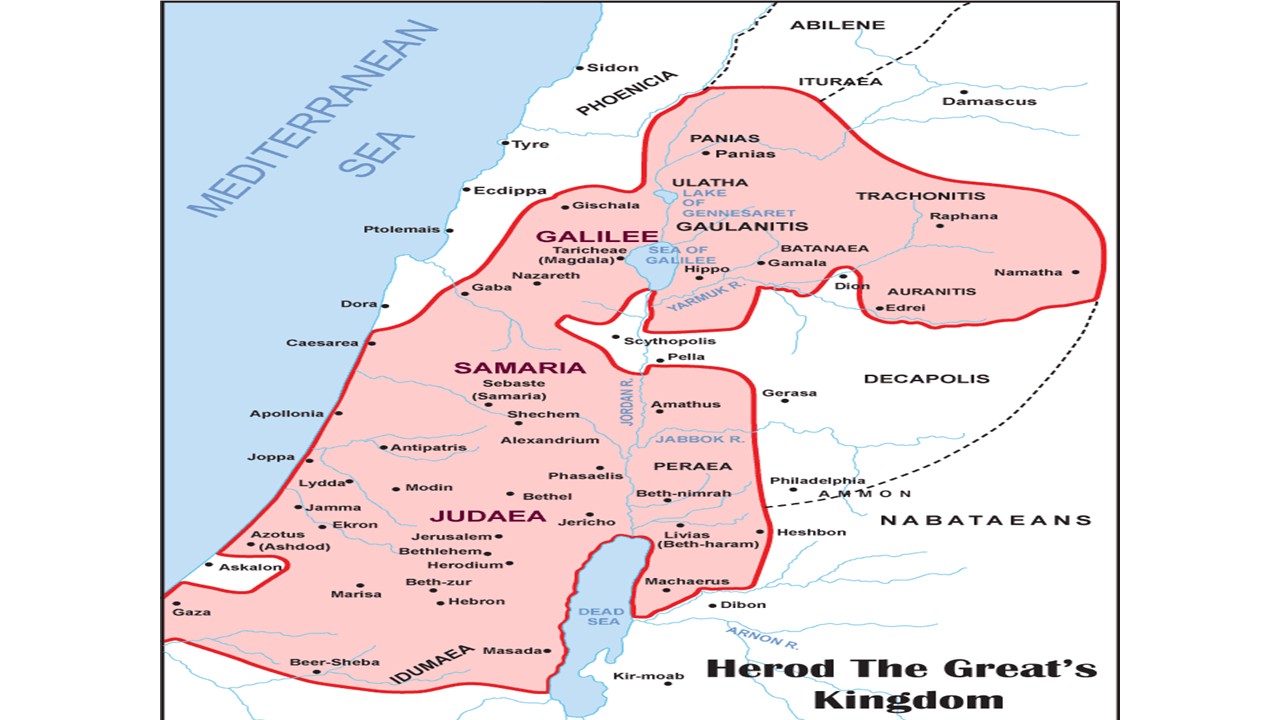
Before Herod, Israel was ruled by the Hasmonean Dynasty (roughly 140 BC to 37 BC when Herod took over). Israel was just one tiny sliver of a nation around Jerusalem. The Hasmonean Dynasty expanded Israel’s borders to include Judea in the south, Samaria, Galilee, Perea, and elsewhere. Because of the Hasmoneans the map of Israel looked the way it did when the Lord was here. In 63 BC, there was a civil war broke out over who would get the crown. This was called the Hasmonean Civil War. The Roman Empire saw this as an opportune moment. They swooped in and conquered when Israel was divided. From that moment forward, Israel became a client state to Rome. They were Israel but now they’re under Rome’s authority.
Jump ahead to 37 BC. The Roman Senate voted to make Herod the new king of the Jews.
Herod refurbished and expanded the second temple, sometimes called Herod’s Temple. He also gave himself a nice big palace in Jerusalem along the western wall in the middle. Below is an image of Herod’s palace from the Holyland Model of Jerusalem. That is a 1.5 scale model of ancient Jerusalem in the days of Jesus based on the writings of Josephus.
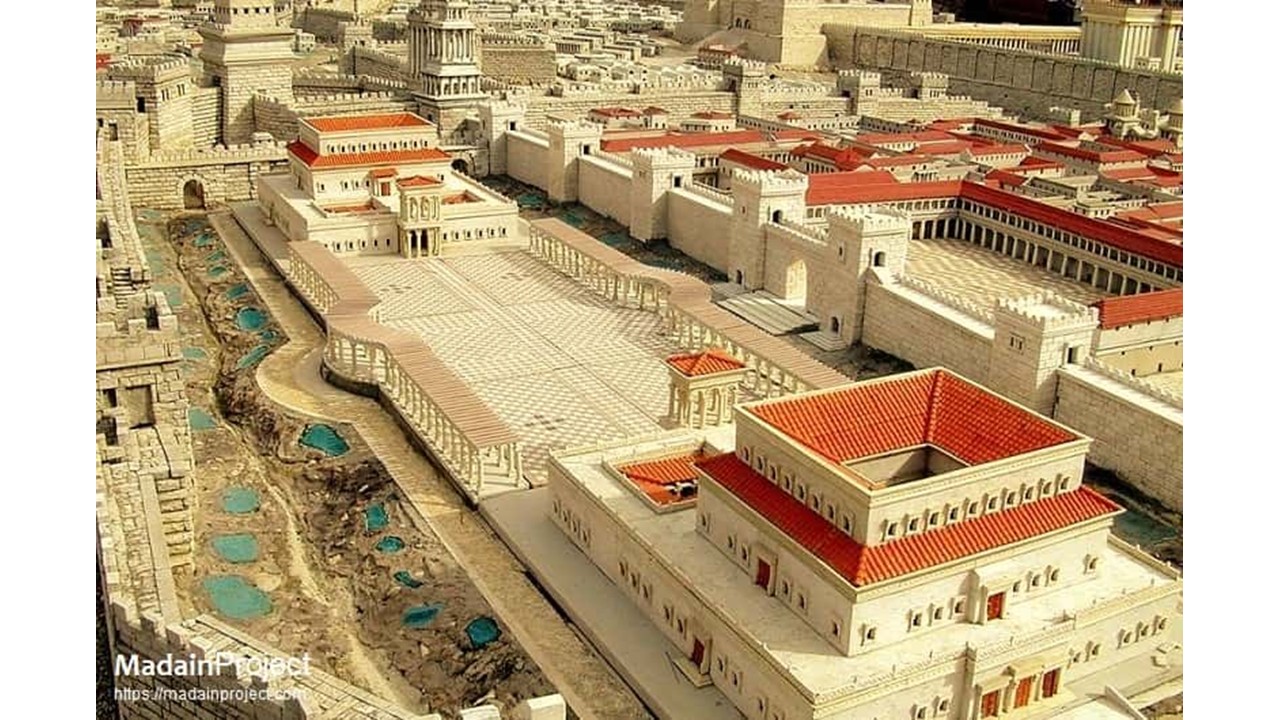
So Herod’s palace was something like this. Nothing of the palace exists today except for portions of the wall around it. Herod’s jurisdiction extended over most of Israel at the time.
Herod would marry one of the Hasmonean daughters, Mariamne I, just so he could secure his throne without a lot of drama, keep the peace with the Hasmoneans, and create some favorable PR for the Jewish public. Herod was already married to a woman named Doris and had a son. He banished them both to marry Mariamne. Not only that, he was so paranoid and insecure about losing his power, he would eventually have some of his own family members murdered, including his new wife, Mariamne.
This brief story we’re given in Matt. 2 is a superb portrait of Herod. He was a man who professed to be a Jew worthy of ruling over the Jews. In reality, he cared only about himself and holding on to his power. He was ignorant of the law. He was ignorant of prophecy. He was paranoid. He was insecure in himself and in his position. There was nothing so diabolical that he would not be willing to carry out for the sake of keeping his power, including the slaughter of innocent male babies to eliminate a future threat.
Herod was also known for his architecture. He had refurbished and expanded the second temple, which everybody loved. Even the disciples the loved Herod’s Temple. But the other colossal buildings he erected in Jerusalem and elsewhere were met with disdain because the architecture was distinctly Roman. The people viewed that as a Romanization of Israel, which is exactly what it was. Herod was nothing more than a slave to Rome while also trying to convince himself he was his own man. He was a slave to his own flesh, too, while also pretending to be as righteous as any other Jew, and he was a slave to his seat of power while also pretending to be subject to the all-powerful God of Israel. Given the disastrous spiritual condition of Israel at the time, Herod was not the leader they wanted, but he was in every way the leader they deserved.
Who were the wise men?
In the second half of 2:1 Matthew writes, “behold, there came wise men from the east to Jerusalem…” He first says behold. We are to take note of this. We are to give attention to this amazing story.
Then he speaks of wise men from the east to Jerusalem. Notice what’s missing here. The word three. We are never told that there were three wise men. Just because they brought gifts of gold, frankincense, and myrrh does not mean there were only three wise men. I believe this was a great entourage. Heads were turning and tongues were wagging when these guys showed up in Jerusalem.
The Greek word for wise men, in the TR, is not magi. It’s magos. Magi is plural. Magos is singular. Modern translations will change the rendering from wise men to magi. Magi never existed in the TR. Magos is singular in the Greek. Magus is the Latin equivalent. Magi is the plural of the singular magus in Latin.
So now we have an interesting dilemma. Why does the TR say magos, which is singular, but the translators gave us wise men, which is plural? Well, they clearly had to because elsewhere in this story the wise men refer to themselves as we (2:2) and Matthew writes they and them (2:7-9).
So what’s a magos?

In the image above, we have both Strong’s Concordance and Strong’s Exhaustive Concordance for magos. Strong’s at the top says “a magian,” which is a magician, “an oriental astrologer,” “a magician.” Strong’s Exhaustive at the bottom says, “an oriental scientist,” “a magician,” “sorcerer,” and “a wise man.” It also tells us the Hebrew counterpart is rab-mawg.
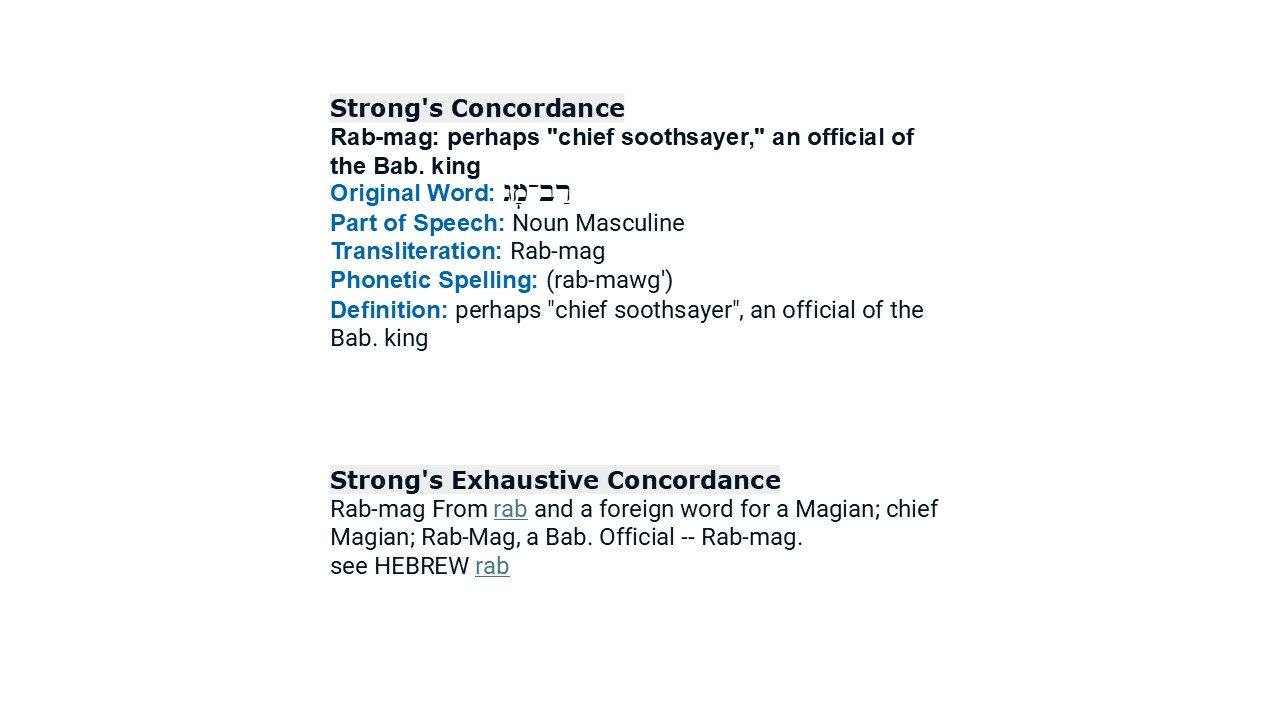
Here we have both Strong’s Concordance and Strong’s Exhaustive Concordance for the Hebrew rab-mawg. Strong’s tells us this is a chief soothsayer, an official of the Babylonian king. Strong’s Exhaustive would tell us much the same but includes magian, or magician.
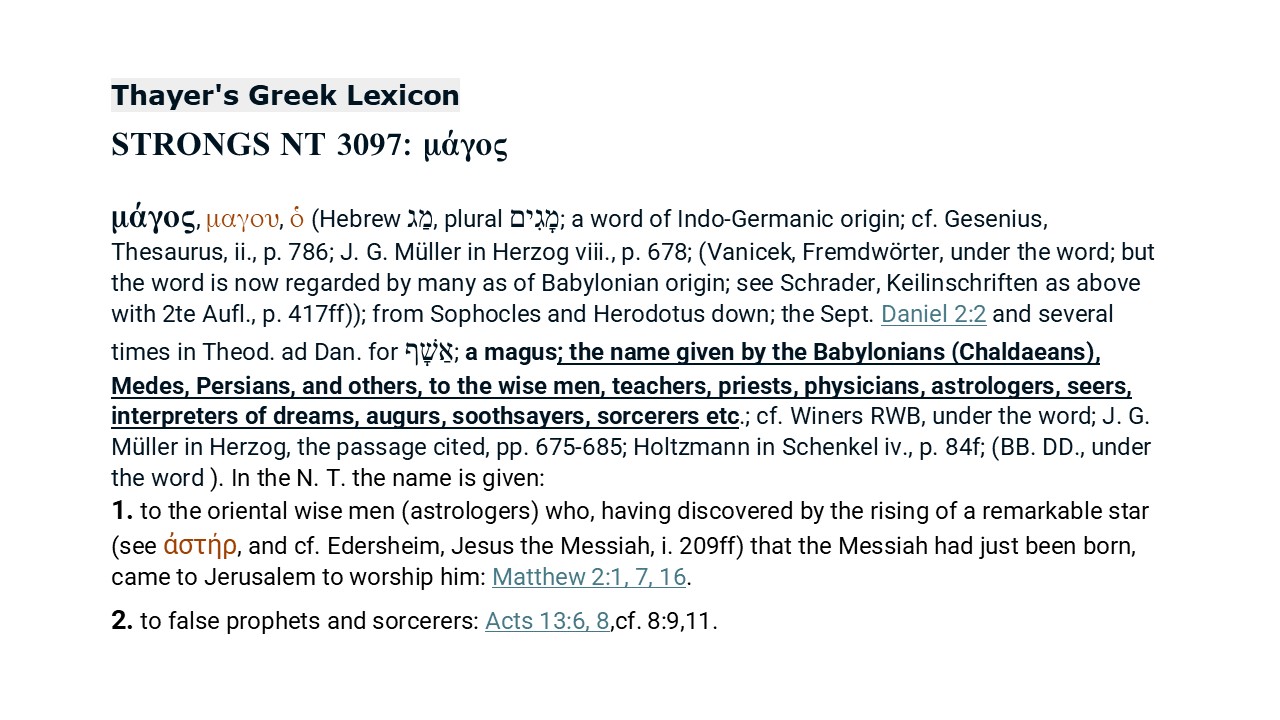
Next, we have Thayer’s Greek Lexicon. Just note what is bold and underlined in the middle: “the name given by the Babylonians (Chaldaeans), Medes, Persians, and others, to the wise men, teachers, priests, physicians, astrologers, seers, interpreters of dreams, augurs, soothsayers, sorcerers, etc.”
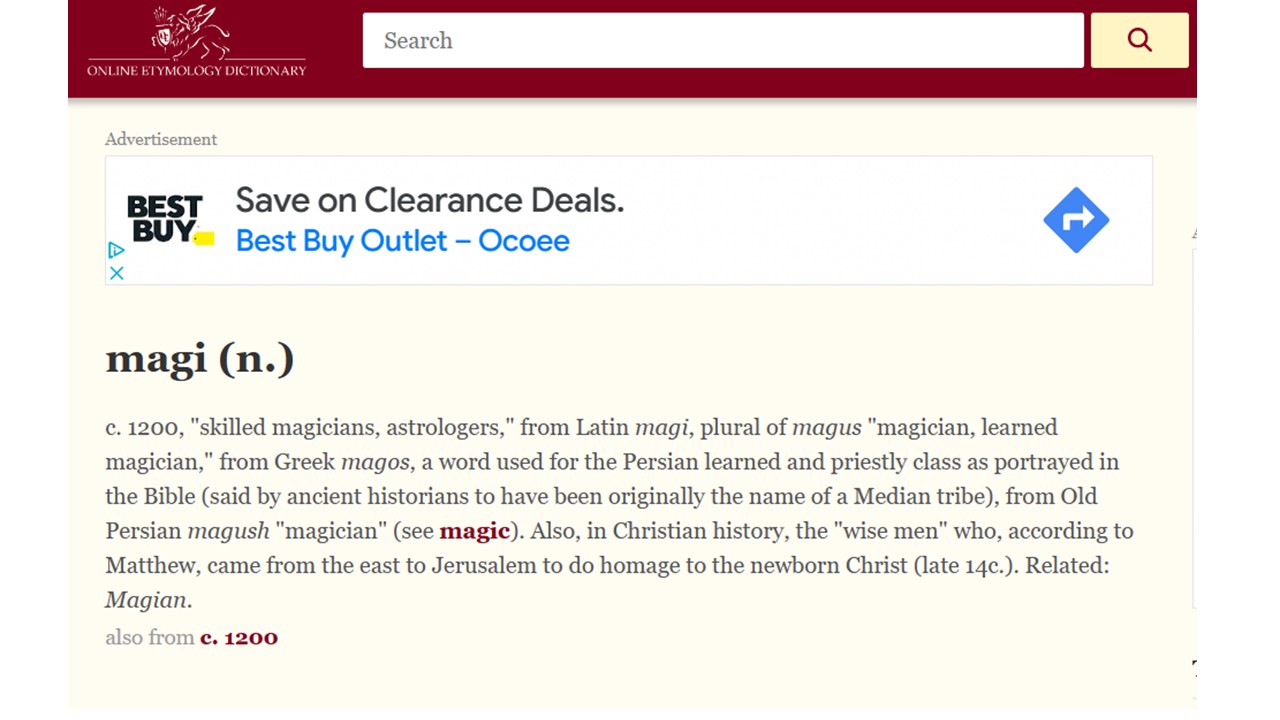
I also included Online Etymology Dictionary’s definition of magi which talks about magos. Notice they say Magi, circa 1200, skilled magicians, astrologers,” from Latin magi plural of magus “magician, learned magician” from the Greek magos a word used for the Persian learned and priestly class as portrayed in the Bible. I really appreciate that point. Magos is singular not because it’s about a single person but because it’s a single class of people. And this class of people is made up of a wide variety of astrologers, magicians, teachers, soothsayers, and priests. The majority of the people in that class of magos are spiritual hucksters.
So what does all of this mean?
In Exod. 7, Moses and Aaron have a big showdown with Pharoah. Aaron just threw his rod down and it became a serpent. Then what did Pharoah do?
Exo 7:11 Then Pharaoh also called the wise men and the sorcerers: now the magicians of Egypt, they also did in like manner with their enchantments.
Pharaoh had his own group of wise men. They were his personal spiritual advisers. They came from all walks of life. They were the learned mystics of the time. They were the sorcerers and the magicians. They were false teachers. They were spiritual hucksters. And they were ALL Pharoah’s wise men. Pharoah viewed them as his wise men, his personal spiritual cabinet, his group of learned mystics he could turn to when he needed advice. They were Pharoah’s personal cabinet of spiritual hucksters.
And they were called wise men but they were anything but wise.
In Dan. 5, Nebuchadnezzar had own wise men, too. When the handwriting appeared on the wall, we’re told in Dan 5:7, The king cried aloud to bring in the astrologers, the Chaldeans, and the soothsayers. And the king spake, and said to the wise men of Babylon, Whosoever shall read this writing, and shew me the interpretation thereof, shall be clothed with scarlet, and have a chain of gold about his neck, and shall be the third ruler in the kingdom.
Who were Nebuchadnezzar’s wise men? They were his counsellors. They came from all walks of life. They were the learned mystics of the time. They were astrologers, Chaldeans, and soothsayers. They were false prophets. And they were all Nebuchadnezzar’s wise men.
This is one of the benefits of being king of the world. You can have your own personal cabinet of spiritual hucksters to tell you lies.
Did Pharoah’s wise men meet the definition of magos? Absolutely.
Did Nebuchadnezzar’s wise men meet the definition of magos? Absolutely.
We have Biblical examples of what the word magos represents. So magos is a Greek word of foreign origin identifying the wise men of a Gentile ruler. This class contains a variety of people from all walks of life – magicians, soothsayers, sorcerers, and all manner spiritual hucksters who made up this group of wise men who gave counsel to a king.
Did Israel have their own wise men, too? They sure did. When they were in the wilderness wise men were designated to be captains over thousands and hundreds and fifties and tens (Deut. 1:13-18). Jewish kings also had wise men as counsellors. David’s uncle was a counsellor and a scribe who was called a wise man (1 Chron. 27:32), but none of the wise men of Israel fit the definition of magos. That is not to say a magos couldn’t also be a Jew.
In Acts 13,Paul and Barnabus encountered a magos, and this was not a good person. Act 13:6 And when they had gone through the isle unto Paphos, they found a certain sorcerer (magos), a false prophet, a Jew, whose name was Barjesus. So this magos who was a Jew was a sorcerer, a magician, someone who deceived through trickery. He was using perhaps even demonic trickery to fool people into thinking he was a true prophet. A magos in this case is not a good thing. He was not a good person. He was a total spiritual huckster, but this magos was also a Jew.
It cannot be said that a magos cannot be a Jew.
Here’s another consideration to make. Some of the commentaries would say that these wise men came from some place east of Judea. I used to think, “That’s not what the verse says.” Vs. 1 says, “behold, there came wise men from the east to Jerusalem…” They simply had to be east of Jerusalem. But at the end of this story, when the wise men went home, Matthew told us in vs. 12 that they departed into their own country. They came from another country. A country is the whole territory of a kingdom.
They have to be Gentiles.
Some of the writers would say that because magos probably has a Persian origin then these wise men had to come from the far east, from Persia. I thought, “What are you talking about? There is no Persia in the days of the Roman Empire.” What existed at the time was
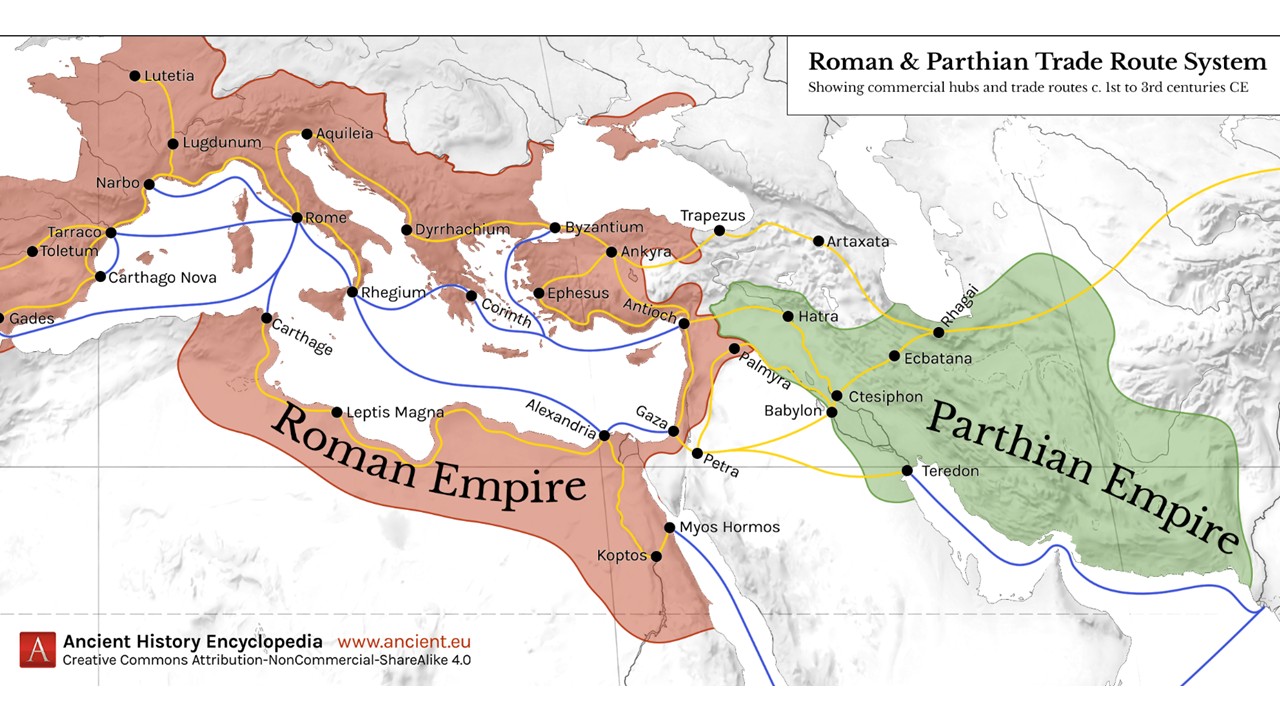
the Parthian Empire. Now that whole green section is modern day Iraq, Iran, Afghanistan, and Pakistan. That is also OT Mesopotamia. That’s Ur of Chaldees where Abraham is from. That’s where we got the Assyrians. That’s where Babylon is located. That’s where we got the other Gentile world empire of the Medes and the Persians. And you remember, Alexander the Great conquered the Persians. He Greekified that entire country. After the Greeks fell, these people were conquered again by the Parthians, who came from the north,
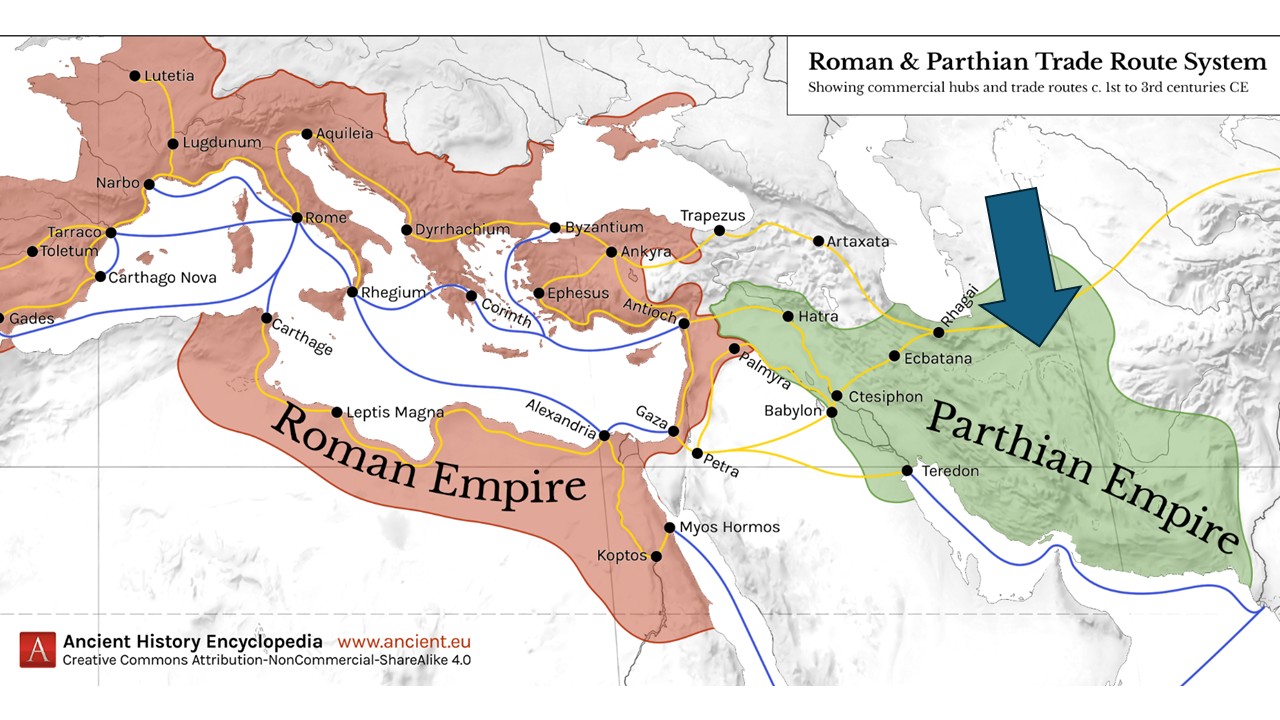
north of the Caspian Sea, in modern day Kazakhstan. So these people have been conquered twice. They’ve had their culture turned upside down twice. They’re no longer Persians. Now they’re speaking Koine Greek. Their old language is dying out.
Historians usually describe the Parthians as a heterogeneous, a mixed bag filled with dissimilar parts – Persian, Greek, and Parthian influences. The Parthians were also unique in that they were very decentralized giving a lot of liberty to local vassals, although the king would lend a guiding hand.
Their religion was laissez faire. Whatever floats your boat. There were Jews who lived amongst the Parthians. Acts 2:9 mentions Parthian Jews were at Pentecost. In 1 Peter 5:13, Peter had visited a little flock church that was in the old city of Babylon.
History remembers the Parthians for one primary thing – they were the toughest people on Earth. They were Rome’s most formidable enemy. They were the only ones on planet Earth who could whip the Romans in battle. If there was one country who put fear into the hearts of the Roman army, it was the Parthians.
What made the Parthians so dangerous was that they were experts at archery while riding horses. These guys were trained to do this from childhood. Right around the time Herod became king, a Roman General named Crassus invaded the Parthians.
In this one battle east of Israel, a Parthian general had 10,000 men. He had 1,000 infantry and 9,000 expert archers on horses. And they were outnumbered 4 to 1.
And they absolutely decimated the Roman the army.
Wikipedia said the Parthians had this trick where they would pretend like they were retreating. This would draw out the Roman infantry to chase after them. Then the Parthians would stop, turn around, and take out all the Romans with the archers.
With tactics like that, they absolutely obliterated the Roman army. Crassus was also captured and executed. These guys put fear into the hearts of Romans. They also went toe-to-toe against Marc Antony and Augustus and whipped them both.
Ultimately, the Roman Empire was, like, “You know what? We can live without that territory. You can keep it. Have a nice day.” There was peace in the days of Jesus and Paul.
At least, the Roman Empire wanted you to think they were at peace. In reality, the Romans were secretly giving money to tribes inside the Parthian Empire to foment rebellions from within to weaken the country. Thus, when they became internally divided, the Roman Army could swoop in and conquer them.
Here’s a link to a great video breaking down the rise and fall of the Parthian Empire. At the end of that video, they point out that in the capital city, the Parthian government had a king and under him were two councils – the nobles and the magi. They were actually called the magi. All the Parthian videos and articles talk about the nobles and the magi.
The magi were wise men in the same vein as Pharoah’s wise men and Nebuchadnezzar’s wise men. The Parthian king’s wise men perfectly fit the textbook definition of magos. The king’s wise men were made up of magicians, astrologers, soothsayers – all manner of spiritual hucksters in the east.
The Parthian Theory
How did these wise men get an audience with Herod the King? Do you think anybody could walk into Herod’s palace in Jerusalem and talk to the king of the Jews? No.
Who could walk into Herod’s palace and get an immediate audience with Herod? If the Parthian king’s magi showed up, would Herod be willing to meet with them? You better believe it.
The Parthians were Israel’s neighbor. They were tougher than the Roman army. Herod wants no trouble with the Parthians.
Why would the King of Parthia send his magi to Jerusalem?
Commentators would say, “Well, Babylon is in that region. They probably knew the story of Daniel and Nebuchadnezzar and they knew about the prophecies.” I wouldn’t dismiss that idea, but I struggle with it. That’s like us holding on to a prediction someone made in the 1500’s. No one cares about what people said in the 1500’s. Remember, there has been a ton of history in that region over the course of 500 years. It wasn’t just the Babylonians but the Medes & Persians, the Greeks, and the Parthians. After all of that history would they still be thinking 500 years later about that Jewish book of Daniel? The Parthians did not care about what the Jews believed. They cared about their own pet religions.
I would offer a different take.
Do you think the news about Jesus’ birth spread like wildfire in Israel? Remember Anna the prophetess (Luke 2:36)? She told everyone the Messiah was here. And Anna was legit. She was a credible source. And people knew the time of Daniel’s prophecy had filled up. The Messiah should be here by now, and Anna was telling the people of Israel, He’s already here born of a virgin in Bethlehem having fulfilled prophecy. This news electrified a nation that was looking for their Messiah.
Do you think it’s possible that Jews living in the Parthian Empire heard about this?
Do you think it’s possible this news may have even reached the ears of the Parthian King?
Do you think this Parthian King would be concerned about a new king in Israel?
He was concerned about strengthening his western border against potential Roman invasions, but now he’s hearing of a new king born in Israel. Is this going to be a problem for him? He’d want to check this out, wouldn’t he? Why not send the magi to assess the political situation in Jerusalem. What are we to make of this new king of Israel? Let’s bring him some gifts to make nice and see what’s going on.
It always struck me as odd how these wise men spoke to Herod. They said in Mat 2:2 Saying, Where is he that is born King of the Jews? for we have seen his star in the east, and are come to worship him. This is unusual dialogue. They’re not talking to Herod like humble constituents. There is bravado in their words. They are practically antagonizing Herod. They’re kinda confrontational and even kinda insulting. What Jew would say to Herod, “Hey, where’s the new guy who’s going to replace you? We want to worship HIM, not you!” Would wise men in Israel truly be wise if they spoke that way to Herod? If a Jew said that to Herod, he’s a dead man.
But these guys can speak that way to Herod and get away with it.
And they know they can get away with it.
Because Herod wants no trouble with the Parthians. I’ll bet the Parthians always thought they could easily conquer Israel if they wanted to, and Rome would probably NOT stand in their way. Rome has already been beaten badly by the Parthians. They’d be thinking, “Is it worth losing another 20,000 soldiers just to keep Israel? Probably not.” They might let them have Israel.
The Parthians knew they could waltz into the palace of the King of the Jews and belittle him and he’d have to take it because Herod couldn’t afford a conflict with the Parthians.
If these wise men were Jews, why would they go to Herod? If they were wise men of Israel, wouldn’t they already know prophecy and go straight to Bethlehem? They wouldn’t be very wise if they knew the Messiah should already be born but knew nothing of Mic. 5:2. Any wise man in Israel would know that prophecy and go straight to Bethlehem without giving himself a lot of headaches by visiting Herod. Who would possibly think that they should ask corrupt Herod, of all people, where the Messiah has been born? I’ll tell you who. Foreign ambassadors, like the magi from the Parthians. If you want answers, go to the top dog.
Notice Herod’s response. Mat 2:3 When Herod the king had heard these things, he was troubled, and all Jerusalem with him.
The assumption by many is that Herod was troubled because he was afraid he’d lose his seat, but notice that all Jerusalem was troubled with him. They were all troubled about the same thing. Would ALL Jerusalem be troubled if Herod was kicked off his throne? No. In fact, they’d celebrate. If the wise men were Jews, and let’s say they came from the other side of Jordan, and they came to Jerusalem because they wanted to see the Messiah, would ALL of Jerusalem be troubled by that? No way! They’d empathize because they all wanted to see Him, too.
The point about Matt. 2:3 is that ALL of Jerusalem was troubled WITH Herod about the same thing. And ALL of Jerusalem would NOT be troubled about Herod losing his job. So everyone would have to be troubled about something else.
What could trouble both Herod and ALL the people of Jerusalem at the same time?
The presence of Parthians.
The presence of Parthians in Jerusalem would make everybody nervous. Nobody wanted trouble with the Parthians. These are the guys who can decimate the Roman army. There is no safety net for Israel if the Parthians invaded.
Mat 2:4 And when he had gathered all the chief priests and scribes of the people together, he demanded of them where Christ should be born. Mat 2:5 And they said unto him, In Bethlehem of Judaea: for thus it is written by the prophet, Mat 2:6 And thou Bethlehem, in the land of Juda, art not the least among the princes of Juda: for out of thee shall come a Governor, that shall rule my people Israel.
So these magi likely addressed Herod publicly in the king’s court. Herod basically says, “Let me have a chat with my people.” He gathers chief priests and scribes. He demands an answer to a question so simple and so easy, I’ll bet you any child in Israel could’ve answered that. Then Herod would take these wise men aside for a private conversation. Mat 2:7 Then Herod, when he had privily called the wise men, enquired of them diligently what time the star appeared. We’re not told the answer. This star was news to everyone in the palace.
I’ll bet you as soon as Herod’s staff heard about that star they went running out of the palace looking up into the sky. “There is a star above the city!” And all the while Herod is enquiring of the wise men diligently what time the star appeared. He grilled them about that star. Herod was desperate for an answer. The appearance of that star probably coincided with the birth of the Messiah. If they can pinpoint exactly when the star appeared, then they’d know exactly what day Jesus was born. They could figure out who gave birth in Bethlehem on that day, and then Herod could have that child killed.
It would seem the wise men did not know exactly when the star first appeared. This is why Herod says what he says. Mat 2:8 And he sent them to Bethlehem, and said, Go and search diligently for the young child; and when ye have found him, bring me word again, that I may come and worship him also. Herod basically says, “Well, since we don’t know when the star first appeared, all we can say is go to Bethlehem and try to find him if you can and if you do, let me know.”
Mat 2:9 When they had heard the king, they departed; and, lo, the star, which they saw in the east, went before them, till it came and stood over where the young child was.
Even though they call this a star, it seems likely that this was a manifestation of the Shekinah glory that had appeared as a point of light similar to a bright star. Baker would write, “The miraculous Light had appeared before, as the glory cloud to give light to Israel when they came out of Egypt, in the most holy place of the tabernacle and temple, from which it departed in the days of Ezekiel (Ezek. 10:4-19). Now the One had come who was the embodiment of the Shekinah glory (cf. 2 Cor. 4:4-6).”
Everything you need to know about this star is right here in Matt. 2:9. This was a miraculous phenomenon. The star that hung over Jerusalem descended from the heavens to be right in front of them, and this star guided these wise men 100 miles from Jerusalem all the way to Nazareth. They did not see the child in the manger, because remember in vs. 11, they came into the house. They were no longer at the inn. They were in the house. This had to be Joseph’s house in Nazareth.
Plus, when Herod orders the death of all those male children, they were to kill all the boys two years and younger. He did that because Jesus wasn’t born yesterday. He didn’t know when the star first appeared which meant he didn’t how long Jesus had been alive. So, to be safe, two years and younger. That should get the job done.
Now Jesus was born end of September, early October. I think this story took place the following year. So Jesus was maybe a year old, not even.
In any event, these wise men went 100 miles from Jerusalem all the way to Nazareth in Galilee. This is a 4 to 5-day journey, even on horses.
Think about that. That star was with them all day. That star was with them all night. That star gave them time to think. They knew that star was incredibly important because that star totally freaked Herod out of his mind, and he’s the King of the Jews. There must be something to this star. This isn’t like the magic tricks they pulled on the Parthian King. This star is the real deal. This star truly is a miracle. This star can only come from the one true God.
It must’ve occurred to them at some point that before them was a genuine miracle of God. And if this star truly was from the God of Israel, then He must be the one true God, and all His prophecies must be true and that must mean that they were actually going to meet the… Redeemer of all mankind that Israel hopes for.
When they finally arrived at Joseph’s house, that star floated right over where the young child was. They felt deep joy seeing Him. They not only rejoiced with exceeding great joy, but they also fell down to their knees and worshipped Him in front of everyone.
Mat 2:10 When they saw the star, they rejoiced with exceeding great joy. Mat 2:11 And when they were come into the house, they saw the young child with Mary his mother, and fell down, and worshipped him: and when they had opened their treasures, they presented unto him gifts; gold, and frankincense, and myrrh.
What do you think is going through Joseph and Mary’s mind? This great entourage of Parthian magi have shown up at their doorstep to worship their son, the King of the Jews! That is as mind-blowing as it gets for a couple of common Jews living in some rural town out in the middle of nowhere in Galilee.
Suddenly, Joseph and Mary are wealthy in a way they had never dreamed they’d be. Because of these gifts from the wise men, they don’t have to worry about money while they’re raising Jesus. And the Parthians could easily afford to extend such expensive gifts out of their treasuries. (Little bit of trivia: frankincense and myrrh were both exports out of Arabia, which was the Parthian’s southern neighbor.)
Beyond all that, we cannot overlook the implication of this story. These Gentiles, these wise men who were the magi to the Parthian King, these spiritual hucksters of the east, by the time they saw Jesus, they all became true believers.
Remember how Matthew first told us to behold these wise men? Why? Because this story is about the conversion of Gentiles from another nation. These Gentile magi were more willing to accept by faith the miraculous signs right before their very eyes, they were more willing to accept those signs by faith than the very people of Israel.
If these Gentile magi can accept that Jesus as the Christ, then what’s your excuse? These wise men were among the first converts in the Gospels… and they were Gentiles. The endgame of the entire prophetic program, the blessing to the Gentiles, the conversion of the Gentiles, is foreshadowed here with these wise men after His birth.
Mat 2:12 And being warned of God in a dream that they should not return to Herod, they departed into their own country another way.
Now that they’re saved, God’s communicating with all these wise men in their dreams.
Notice that the Lord wasn’t speaking to them in a dream. This was God the Father. This is completely unprecedented, the Father speaking to Gentiles in a dream! These guys heard the voice of God the Father. He didn’t simply speak to one man. He spoke to all of the wise men in a dream that they should not return to Herod.
Of course, God the Father didn’t want them to return to Jerusalem, to talk to Herod, or be anywhere near Jerusalem. Why? Because He didn’t want Herod to find out where His Son was located. He knew Herod’s intent, and He wanted to keep him in the dark.
We are witnessing here for the first time the actual intervention of God the Father in the affairs of mankind on Earth.
 SUPPLY OF GRACE
Leave a comment