
Pro 31:10 Who can find a virtuous woman? for her price is far above rubies. Pro 31:11 The heart of her husband doth safely trust in her, so that he shall have no need of spoil. Pro 31:12 She will do him good and not evil all the days of her life. Pro 31:13 She seeketh wool, and flax, and worketh willingly with her hands. Pro 31:14 She is like the merchants’ ships; she bringeth her food from afar. Pro 31:15 She riseth also while it is yet night, and giveth meat to her household, and a portion to her maidens. Pro 31:16 She considereth a field, and buyeth it: with the fruit of her hands she planteth a vineyard. Pro 31:17 She girdeth her loins with strength, and strengtheneth her arms. Pro 31:18 She perceiveth that her merchandise is good: her candle goeth not out by night. Pro 31:19 She layeth her hands to the spindle, and her hands hold the distaff. Pro 31:20 She stretcheth out her hand to the poor; yea, she reacheth forth her hands to the needy. Pro 31:21 She is not afraid of the snow for her household: for all her household are clothed with scarlet. 31:22 She maketh herself coverings of tapestry; her clothing is silk and purple. 31:23 Her husband is known in the gates, when he sitteth among the elders of the land. 31:24 She maketh fine linen, and selleth it; and delivereth girdles unto the merchant. 31:25 Strength and honour are her clothing; and she shall rejoice in time to come. 31:26 She openeth her mouth with wisdom; and in her tongue is the law of kindness. 31:27 She looketh well to the ways of her household, and eateth not the bread of idleness. 31:28 Her children arise up, and call her blessed; her husband also, and he praiseth her. 31:29 Many daughters have done virtuously, but thou excellest them all. 31:30 Favour is deceitful, and beauty is vain: but a woman that feareth the LORD, she shall be praised. 31:31 Give her of the fruit of her hands; and let her own works praise her in the gates.
Introduction
Let’s start with Proverbs as a whole. Proverbs in Hebrew is called “Mishle,” derived from “Mashal,” which means “to rule.” So Proverbs is filled with short sayings designed to govern life and one’s conduct. Whereas Psalms was designed for your devotional life, Proverbs was designed for your practical life. And many of these proverbs are concentrated parables. They are concise, condensed forms of parables — short, powerful statements packed with meaning.
Not every proverb in this book originated from Solomon. There are times when Solomon is quoting someone else and that is what’s happening here in Proverbs 31.
Pro 31:1 The words of king Lemuel, the prophecy that his mother taught him.
This brings us to Three Broad Points about Proverbs 31.
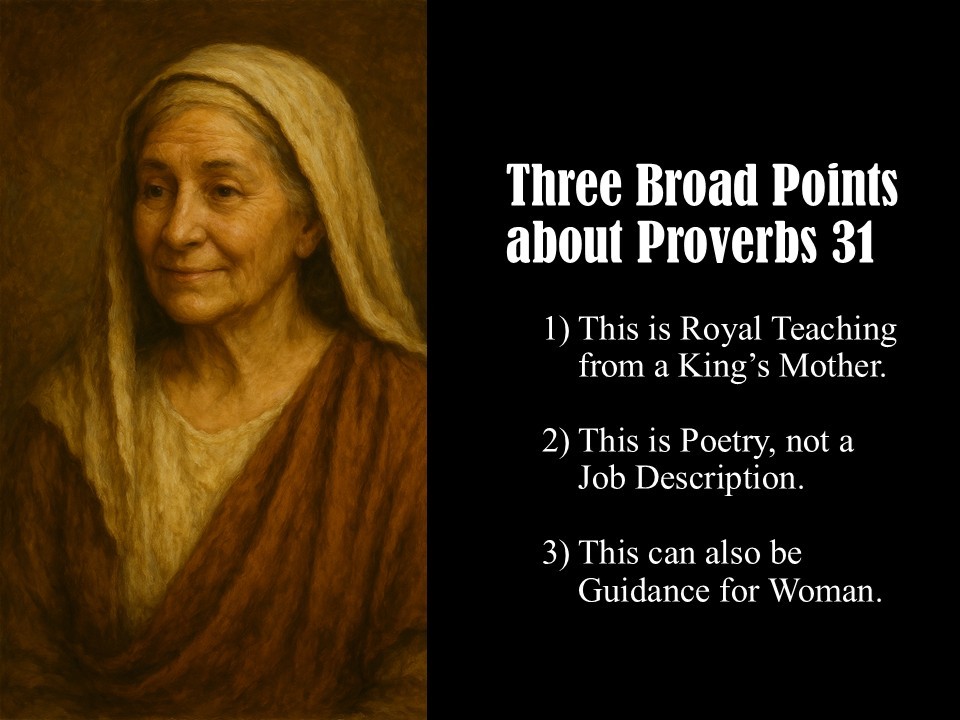
This is Royal Teaching from a King’s Mother
This is the advice of a queen training her son on how to lead well and choose a virtuous woman for a wife.
Who was King Lemuel? He is nowhere to be found in Scripture or in history books. The consensus by both Jews and Christians is that this Lemuel is King Solomon. Bullinger would point out that Solomon was called by six different names with Lemuel being one of them.
If that’s true, then this means that what we just read, this whole chapter in fact, are the words of Bathsheba. This makes perfect sense to me, because in the first chapter, we have “My son” and the words of his father David, and now here, in the last chapter, we have “My son” and the words of his mother Bathsheba.
Pro 31:2 What, my son? and what, the son of my womb? and what, the son of my vows?
I love that she says the son of my vows. She made vows to God about Solomon, which might explain the name Lemuel, which means “belonging to God” or “dedicated to God.” Her vow may have been something along the lines of “If you allow me to have this child, I will give him back to you, like Hannah.” And that’s exactly what she did.
There are a couple of short stories about Bathsheba in 1 Kings 1 & 2 and you get the sense that Bathsheba was very involved in the raising up of Solomon and trying to mold his thinking, and Solomon even after he took the reigns of power, always treated her with great respect.
And so Bathsheba says here, What, my son? and what, the son of my womb? and what, the son of my vows? The repetition isn’t simply poetic but conveys a kind of deep, anxious love about her son. She loves her son deeply. She knows him perfectly. And she knows that he has issues about women, which would ultimately be Solomon’s downfall. And so she is worried about this problem. This is why she teaches him this proverb. She taught him this proverb in a poetic form so these thoughts would stick with him. And Solomon here is merely recounting what she taught him.
In vs. 3, she warns him about chasing women. She says, Give not thy strength unto women, nor thy ways to that which destroyeth kings (Pro 31:3). In other words, it’s a waste of energy to sow any wild oats you may be feeling. It’s a waste of energy chasing women. It’s a waste of energy engaging in things like drunkenness because that destroys kings. Then she warns about alcohol until vs. 9, and then famously, celebrates the virtuous woman.
But even this brilliant poetry from his mother doesn’t deter Solomon from being involved with strange women, which will be his undoing.
You can’t help but take note of the irony here. This beloved chapter of Proverbs 31 celebrating the virtuous woman was likely taught by a woman who is most known for her adulterous affair with David. So we may glean from this a few point:
- She may have always been devoted to a principled, holy, sanctified walk, but David was her one big mistake.
- Or after having been busted for this sin with David and came close to being put death under the law, she may have rededicated herself to the Lord and a virtuous life.
- Or she is simply elevating the virtuous woman for Solomon’s sake because she knows him too well.
- One does not need a perfect past to give good advice, and in fact, having made mistakes reinforces that these lessons were learned the hard way. So don’t do what I did.
This is Poetry, not a Job Description
From vs. 10 to the end of the chapter, in the Hebrew, it’s written as an acrostic poem, meaning each verse begins with a different letter of the Hebrew alphabet.
Why did she do that? Because this makes the proverbs easier to remember — so this wisdom will stick with you and be passed down to future generations.
The poetic design suggests that this was meant to be a comprehensive portrayal of virtue in action, rather than a literal checklist of things that every women must do. This wasn’t designed to be guidance for women. This was designed to be guidance to help Solomon choose a virtuous woman to marry. These are works that Solomon could see in virtuous women, which should help HIM to find one virtuous woman he could marry.
This is why we don’t read about children or how those children were raised. She’s still single in Prov. 31. These are simply qualities that would make this woman a good candidate to be the wife of the king of Israel. You’re not just marrying Solomon, you’re taking on a role, and you need to be good at that role. A virtuous woman who runs her own business, who has good business acumen, makes her a great candidate for that role as the 1st Lady of Israel.
This isn’t about what every woman should be doing in her life. This is about a woman with qualities fit to become the wife of a king.
This can also be Guidance for Woman
If these are works Solomon should observe commonly in virtuous women, then these works would also give some guidance for virtuous women. So ladies looking to find modern application here, this isn’t really about imitating all these works as it is about applying the principles that those works embody. This is meant to inspire the principles found not dictate specifics that every woman must do.

Exegesis
We’re going to exegete every verse. Because there are so many verses, we’re going to hit the highlights for each verse and keep moving. At the end, we’ll list all the principles of a virtuous woman found in this chapter.
Pro 31:10 Who can find a virtuous woman? for her price is far above rubies.
Notice that the virtuous woman is very proactive, good at buying and selling, and thus, she knows a good bargain when she sees it, which is contrasted with her incomparable value for being virtuous. We read, Who can find a virtuous woman? That is the big headline to this whole section. The long list here of praiseworthy works reinforces the fact that the virtuous woman is a kind of rarity, but she’s not impossible to find.
Here’s Webster’s definition:
VIR’TUOUS, adjective 1. Morally good; acting in conformity to the moral law; practicing the moral duties and abstaining from vice; as a virtuous man. 2. Being in conformity to the moral or divine law; as a virtuous action; a virtuous life. 3. Chaste; applied to women.
Some books point out that the Hebrew word for “virtuous” (khah’-yil) is also used to describe valiant men, warriors. So in the Hebrew, virtuous also signifies strength, valor. There is power in virtue. So a Godly woman with a sanctified walk would have power, or a great influence within her sphere.
Did you know that there’s only one person in the Bible called “virtuous?”
Ruth!
In Ruth 3:11, Boaz would say to her, “for all the city of my people doth know that thou art a virtuous woman.” If you know Ruth, you know she wasn’t doing everything that’s listed in Prov. 31. She didn’t have her own business. She wasn’t buying up land. Ruth illustrates that no woman has to be doing all the things listed in Prov. 31 to qualify as the virtuous woman.
A few points need to be made about this phrase a virtuous woman. A saved person by definition is, virtuous, or righteous, or a good person in their standing before God. This isn’t about a woman’s justification being measured by the things she does. This is about the evidence of a virtuous walk in a saved woman. This is about seeing wisdom in action in a saved woman. This is about seeing a saved woman being productive, industrious, serving the Lord, taking care of her family, and being a reliable, resourceful contributor to the household.
And we would read that her value is far above rubies. Why rubies? There is something else in Proverbs that is also described as having value that is far above rubies. And what is that? Wisdom:
Pro 3:13 Happy is the man that findeth wisdom, and the man that getteth understanding. Pro 3:14 For the merchandise of it is better than the merchandise of silver, and the gain thereof than fine gold. Pro 3:15 She is more precious than rubies: and all the things thou canst desire are not to be compared unto her.
Wisdom is greater and more precious than rubies. Rubies were of great value for a variety of reasons, but some of its most notable qualities is its hardness and durability. They’re one of the hardest gemstones second only to diamonds. So rubies can endure the test of time, and they are unbreakable – just like God’s wisdom.
Pro 31:11 The heart of her husband doth safely trust in her, so that he shall have no need of spoil.
Her husband can trust her with the care and management of the household and even a business. In all that she does, her husband trusts her. Then the verse says so that he shall have no need of spoil. In other words, he is not lacking in basic necessities at home.
Pro 31:12 She will do him good and not evil all the days of her life.
In this verse, she isn’t simply faithful in her walk. We find that there is also a consistent dedication to doing good works. But this isn’t good works generally. This is good works for her husband. And notice that the virtuous woman is dedicated to maintaining good works regardless of how people, or her husband, behave. How people behave doesn’t determine whether or not she’s going to do good works for them. She does the good works because she’s serving the Lord.
Pro 31:13 She seeketh wool, and flax, and worketh willingly with her hands.
Wool, obviously, used to make clothes. But flax was for both clothes and food. It’s cultivated for its fiber and seeds. The fiber is used to make linen, and the seeds are rich in omega-3 fatty acids. So they are consumed for health benefits. The implication here (because of the references to wool and flax) is that the virtuous woman will at times make clothes and food. This doesn’t mean that every woman has to do these things. The big takeaway here is that she does things with her hands. She’s a resourceful contributor to the household.
Pro 31:14 She is like the merchants’ ships; she bringeth her food from afar.
She acts like the merchants. She buys and sells in the markets. She brings things to sell in the market. She is able to take what she has profited and use that to acquire foreign foods that were shipped in. This is just another illustration reinforcing the fact that she’s a resourceful contributor to the household.
Pro 31:15 She riseth also while it is yet night, and giveth meat to her household, and a portion to her maidens.
She’s an early riser. She embodies the expression, “The early bird catches the worm,” which is technically a man-made proverb, but a good one. Those who start their day early or take the initiative tend to find success. This one is for Inge. There is also a German proverb that says, “Morning has gold in its mouth.” In other words, the early hours are full of potential and opportunity. I personally like this proverb, “Lose an hour in the morning, and you’ll be hunting for it all day.” That’s true for me. A late start can totally throw off an entire day’s productivity. But notice why the virtuous woman gets up early. To prepare food for her household, including her maidens, which are female servants. So the virtuous woman wasn’t stuck doing all the housework. She had help. And before the day had begun, they all had food, work to do, and tasks appointed. Everything was done in an orderly manner.
Pro 31:16 She considereth a field, and buyeth it: with the fruit of her hands she planteth a vineyard.
She’s buying land on her own. Some of the books would say, look, she’s not leaning on her husband’s income to buy the land. She’s using her own money. Let’s not forget the context. This is about finding a virtuous woman for Solomon to marry. In this example, she’s single.
Anyway, she’s also investing her money in a new vineyard to bring in more money. Notice what’s going on here. This is a different world. She’s not staying home. She’s engaged in secular business. She’s buying and selling home goods in an unregulated market in which everyone is buying and selling goods. They all know each other. Then, she takes all the profit she’s saved up, and on her own volition, she goes and buys land. She buys that land, she has the money to pay for it in full. She doesn’t go into debt to buy the land. She pays for it in full with the money she’s saved up. She’s a good manager, whether it’s a household or a business.
Pro 31:17 She girdeth her loins with strength, and strengtheneth her arms.
This means that all you women have to get some dumbbells and do curls every morning. I know what some of you are thinking: “I have my dumbbell. He’s sitting next to me.” That’s not what I’m talking about or this verse for that matter. She girdeth her loins meant she put her robe on and tightened her belt. She is equipping herself for any challenge that may come. Strengtheneth her arms is also a way of saying she’s equipping or preparing herself for whatever may come. She’s a prepper to a certain degree. This verse just highlights that the virtuous woman is prepared. She’s ready to take on challenges with some confidence.
Pro 31:18 She perceiveth that her merchandise is good: her candle goeth not out by night.
The stuff she has in her household is quality stuff. She doesn’t buy junk that breaks down two weeks later like our stupid dishwasher. She finds good stuff cheap. Her candle goeth not out by night. Some homes would have candles that burn all night because it deterred thieves from breaking in. And the virtuous woman always kept a healthy reserve of oil for the lamps.
Pro 31:19 She layeth her hands to the spindle, and her hands hold the distaff.
Again, she works with her hands. She learned it. She practiced it. Now she’s skilled at it. Here’s a diagram.

The spindle and the distaff were used for wool and flax. The point was that they used the spindle to unspin the fibers in the wool or the flax. So they’re untangling the fibers found in the wool or the flax, which they would later use for sewing.
Pro 31:20 She stretcheth out her hand to the poor; yea, she reacheth forth her hands to the needy.
Notice the first half of this verse says hand while the second half of this verse says hands. Plus, in the first half of this verse she stretcheth out her hand but in the second half of this verse she reacheth forth both hands. When you’re stretching, you’re just extending your arm and your hand, but when you’re reaching, you’re extending toward something specific. Notice also in the first half of this verse she helps the poor, but in the second half of this verse she helps the needy. Poor is someone who lacks money. Needy is someone who seriously needs your help, whether it be physical, emotional, situational. So with one hand she willingly helps the poor, but with both hands, she looks for and helps those who seriously need help.
Pro 31:21 She is not afraid of the snow for her household: for all her household are clothed with scarlet.
She’s like the many animals that prepare for the winter. She’s like the deer, or the rabbits, or the foxes who grow thicker fur to insulate against the cold in wintertime. The virtuous woman prepares for winter. She’s not afraid or worried about the snow because she has all she needs.
Pro 31:22 She maketh herself coverings of tapestry; her clothing is silk and purple.
Tapestry is like a block of pretty woven carpeting (again made with wool and flax) that you’d hang up on the walls. Today, you’d see pretty tapestry hanging on a wall in a castle merely for decoration…

…but back then, the tapestry was used to hold in the heat and keep down the drafts. Her clothing is silk and purple. The point of purple is that it was popular and highly sought after because the purple dye for clothes was hard to get. So the fact that she wears fine linen that’s purple speaks to her own business acumen and resourcefulness in that she could make enough money to have, nothing overly extravagant, but nice, tasteful outfits.
Pro 31:23 Her husband is known in the gates, when he sitteth among the elders of the land.
The point here is that the wife contributes to her husband’s good reputation amongst the brethren in Israel. He is that much more respected and appreciated and asked to sit with the elders because of his virtuous wife.
Pro 31:24 She maketh fine linen, and selleth it; and delivereth girdles unto the merchant.
She is her own special clothing brand. But she also seems to be adept at crafting leather belts and she’s on time delivering sold goods. She didn’t just make and sell her leather belts, but she delivered them, too.
Pro 31:25 Strength and honour are her clothing; and she shall rejoice in time to come.
Does she have strength because vs. 17 told us she strengtheneth her arms? No. This reinforces what we were told about Hebrew word for “virtuous” (Chayil – khah’-yil). Virtue signifies strength and capability. There is power in virtue. So a Godly woman with a sanctified walk exhibits the strength found in a life of Godliness and the dignity and integrity that comes with it. Then Solomon writes, she shall rejoice in time to come. Because of her works and her honorable walk, she will be rewarded by God in her life and in the life to come.
Pro 31:26 She openeth her mouth with wisdom; and in her tongue is the law of kindness.
Wisdom is the application of knowledge, and therefore, when the virtuous woman speaks wisdom, she’s talking about the application of the rightness of God’s ways to day-to-day living. When she speaks wisdom, she’s talking about the application of the Lord’s principles commanded in the Word of God. My favorite example is 1 Cor. 13. In any given situation, how can agape love be applied to that situation? Well, this virtuous woman would have some ideas about that. Then Solomon says in her tongue is the law of kindness, you’re seeing in her wisdom in action. You’re seeing the application of the rightness of God’s ways in how she speaks and interacts with others. So what does the law of kindness mean? The words that come from the lips of the virtuous wife are as a law. They act as instruction for everyone else. Her words of kindness teaches everyone who hears her about the nature of kindness. Kindness is found in what she says and how she says it. And if we find in her tongue the law of kindness, then she is also a woman of deep love, true agape love, true charity because “kindness ever accompanies love.” And this practice is called a law in her tongue, because it is constant, because her love is constant, and her love is constant because it has been matured through the study of His Word. And this kindness gives her a commanding power and influence in all that she says. Her kind words command respect. They demand kindness in return. All of this is a distinguishing aspect of excellence in the virtuous woman. She doesn’t lord over her husband. She’s not a tyrant over children. She’s not controlling with her friends, but she exhibits love, and the evidence of that love is heard in all of her kind words.
Pro 31:27 She looketh well to the ways of her household, and eateth not the bread of idleness.
I love that phrase, She looketh well to the ways of her household. One book said that she doesn’t just supply food and clothes that are needed, but she is also and primarily a kind of “moral manager.” She takes care that everyone behaves themselves, that none of them keeps bad company or falls into sinful habits. There is a kind of spiritual industry, or an industrious spirituality, that has become the law of her house. She can instruct them in the ways of the Lord, and she can teach them how to labor. “In her house, diligence in business, and fervency of spirit, serving the Lord, go hand in hand.”
Pro 31:28 Her children arise up, and call her blessed; her husband also, and he praiseth her.
If you don’t have children praising you for what you did, that doesn’t mean you were never a virtuous woman. If kids had to grow up and be perfect to validate a virtuous woman, no one would make the cut. God Himself would be a failure of that standard since all of His children fell into sin, and the One who didn’t suffered for all those who did. The sense here is just acknowledgement and appreciation for all she’s done.
Pro 31:29 Many daughters have done virtuously, but thou excellest them all.
This may well be praise from the Lord. I’m sure every woman looks at this and goes, “There is no way I could possibly do or be all these things listed in this chapter!” And you’d be correct. That is why this verse says Many daughters have done virtuously, but thou excellest them all. Any woman who manages to accomplish every single thing in this list, is a woman who has excelled beyond every virtuous daughter who has ever lived. The point has never been that every woman needs to do everything listed in this chapter. The point is to embody the principles that were illustrated by the works you read in this chapter.
Bathsheba herself would sum up the point of this whole teaching. Pro 31:30 Favour is deceitful, and beauty is vain: but a woman that feareth the LORD, she shall be praised.
The woman who reveres the Lord, who dedicates herself to serving the Lord, the woman who has that grace that gives life to the soul, that refines everything she says and does, she shall be praised by both men and God. Then we read Pro 31:31 Give her of the fruit of her hands; and let her own works praise her in the gates. Let her do her thing. Let her enjoy the fruit of her labors. And let her be praised when that opportunity comes.
Conclusion
I’m going to close with this. We said that the point of the virtuous woman is to excel at the principles that were illustrated by the works that are in this chapter.
So what were those principles? (See the photo below.)

 SUPPLY OF GRACE
Leave a comment