
In Luke 13, a few Pharisees came to Jesus with a warning as the Lord was traveling to Jerusalem. “The same day there came certain of the Pharisees, saying unto him, Get thee out, and depart hence: for Herod will kill thee” (Luke 13:31).
The Lord responds with a message for Herod (Luke 13:32-33) that was both a warning and declaration that He’s going to keep doing what His Father sent Him to do until He’s “perfected,” that is, until He is risen again into a new glorified resurrected body.
What follows is a lamentation about Jerusalem’s history of murdering the prophets.
“O Jerusalem, Jerusalem, which killest the prophets, and stonest them that are sent unto thee; how often would I have gathered thy children together, as a hen doth gather her brood under her wings, and ye would not!” (Luke 13:34)
He first says, “O Jerusalem, Jerusalem.” Him repeating “Jerusalem” in this way is a powerful rhetorical device. He’s conveying intense emotions, profound sorrow, and urgent pleading. This is a cry straight from the heart of the Lord.
And when He says “Jerusalem,” He doesn’t simply mean the physical city, but He’s also speaking to the spiritual heart of the nation of Israel. This is where the Temple has always been, and ironically, this is also the place where God’s prophets were murdered.
He says, “how often would I have gathered thy children together.” This is rhetorical. He’s emphasizing the voluminous number of times He wanted to bring them back into communion with Him, which meant for them peace, safety, and blessing, and guidance and wisdom about the perils that existed in the world.
The Lord was never callous about Israel. He felt deeply about them. He longed for them as one who longs for someone they love dearly. He says He would have gathered His children together. Even the act of gathering the saints away from idolatry and sin unto Himself was an emotional act for Him because He loved them so deeply. This statement is filled with heartfelt longing for His sheep who have gone astray and just how emotionally gratifying it would have been for the Lord to have brought them unto Himself.
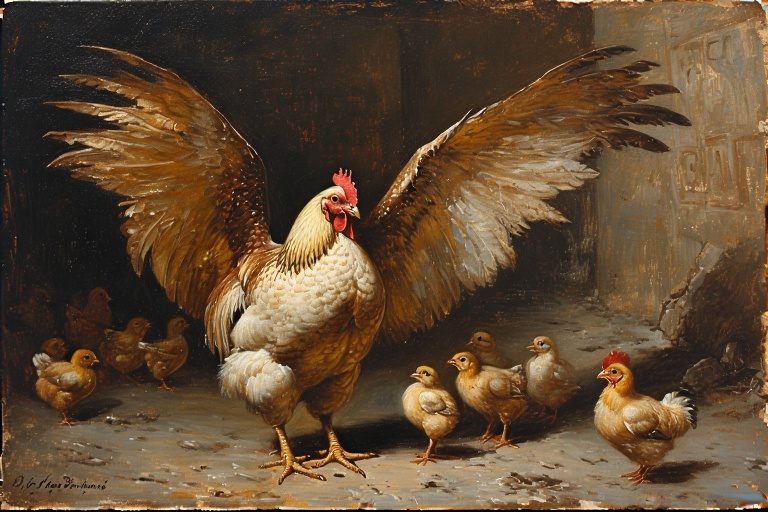
Then He compares Himself to a lowly hen. He says, “as a hen doth gather her brood under her wings, and ye would not!”
An incredibly tender, poignant, and frankly, maternal visual.
A hen gathering her chicks under her wings also speaks of fierce protection of those hens. Not only protection, but they’re also given warm shelter, security, and tender care. All of this speaks to their vulnerability and how desperately His people need Him.
This kind of imagery is also found in the OT.
David writes, “Keep me as the apple of the eye, hide me under the shadow of thy wings, From the wicked that oppress me, from my deadly enemies, who compass me about” (Psa 17:8-9).
He also wrote, “How excellent is thy lovingkindness, O God! therefore the children of men put their trust under the shadow of thy wings” (Psa 36:7).
Plus, he wrote, “He shall cover thee with his feathers, and under his wings shalt thou trust: his truth shall be thy shield and buckler” (Psa 91:4).
His wings symbolized truth.
I found it so moving the Lord would portray Himself (and by extension, God’s character also) as a loving, protective parent figure, yearning with deep compassion to provide shelter, and security, and spiritual nourishment for His people. How much He genuinely wanted to protect them from dangers and judgment.
Then the Lord says, “and ye would not!”
In those four words Calvinism’s entire house of cards collapses. No God who is forcing people to do what He wants, forcing people to believe or be damned, no God acting that way would EVER say such a thing as the Lord says here.
This is a heartbreaking climax to everything the Lord just said. He loved them. He wanted to protect them. He wanted to save them, “and ye would not!”
This is nothing less than the free will of man deliberately and persistently rejecting His love by refusing to accept His invitation to commune with Him. This is God having a desire for Israel motivated by love that has been completely thwarted because of man’s free will proving conclusively that Calvinism is heresy.
Calvinism is nothing less than an assassination of the integrity of God. Luke 13:34 underscores the tragedy of divine love rejected by free-willed human beings and this shows that God is not forcing anyone to do anything. Despite God’s tender love for them and His expressed desire to gather and protect His people, they might as well have slapped Him in the face. It has that degree of sting to it.
Here are three major points about the Lord’s powerful lament here.
His lament reveals to us:
God’s Suffering and Tender Love: The Lord here expresses immense, compassionate, and persistent love and desire to protect His people, likening it to a mother hen’s self-sacrificing care for her vulnerable chicks. The verse reveals deep emotional suffering over their rejection of His love. It’s a lament of rejected love.
Historical Pattern of Rejection: Jesus is basically condemning in advance what they’re about to do to Him because Jerusalem has a long, consistent, historical pattern of murdering God’s prophets, and this pattern will culminate in their crucifixion of Christ, their Messiah, which is the most egregious murder of them all.
Human Responsibility and Free Will: The ultimate cause of the Lord’s lament is their own willful and repeated rejection of His divine will. Their condemnation was a consequence of their choice, not God’s unwillingness to force them to have faith and be saved.
 SUPPLY OF GRACE