

Luke 15:11 And he said, A certain man had two sons: 15:12 And the younger of them said to his father, Father, give me the portion of goods that falleth to me. And he divided unto them his living. 15:13 And not many days after the younger son gathered all together, and took his journey into a far country, and there wasted his substance with riotous living. 15:14 And when he had spent all, there arose a mighty famine in that land; and he began to be in want. 15:15 And he went and joined himself to a citizen of that country; and he sent him into his fields to feed swine. 15:16 And he would fain have filled his belly with the husks that the swine did eat: and no man gave unto him. 15:17 And when he came to himself, he said, How many hired servants of my father’s have bread enough and to spare, and I perish with hunger! 15:18 I will arise and go to my father, and will say unto him, Father, I have sinned against heaven, and before thee, 15:19 And am no more worthy to be called thy son: make me as one of thy hired servants. 15:20 And he arose, and came to his father. But when he was yet a great way off, his father saw him, and had compassion, and ran, and fell on his neck, and kissed him. 15:21 And the son said unto him, Father, I have sinned against heaven, and in thy sight, and am no more worthy to be called thy son. 15:22 But the father said to his servants, Bring forth the best robe, and put it on him; and put a ring on his hand, and shoes on his feet: 15:23 And bring hither the fatted calf, and kill it; and let us eat, and be merry: 15:24 For this my son was dead, and is alive again; he was lost, and is found. And they began to be merry. 15:25 Now his elder son was in the field: and as he came and drew nigh to the house, he heard musick and dancing. 15:26 And he called one of the servants, and asked what these things meant. 15:27 And he said unto him, Thy brother is come; and thy father hath killed the fatted calf, because he hath received him safe and sound. 15:28 And he was angry, and would not go in: therefore came his father out, and intreated him. 15:29 And he answering said to his father, Lo, these many years do I serve thee, neither transgressed I at any time thy commandment: and yet thou never gavest me a kid, that I might make merry with my friends: 15:30 But as soon as this thy son was come, which hath devoured thy living with harlots, thou hast killed for him the fatted calf. 15:31 And he said unto him, Son, thou art ever with me, and all that I have is thine. 15:32 It was meet that we should make merry, and be glad: for this thy brother was dead, and is alive again; and was lost, and is found.
This story is often called “The Prodigal Son,” although “prodigal” is never used in the Bible. People usually think “prodigal,” means rebellious or lost. Prodigal actually means “wasteful” or “extravagant.” Webster’s 1828 says: “Given to extravagant expenditures; expending money or other things without necessity; profuse, lavish; wasteful; not frugal or economical; as a prodigal man; the prodigal son. A man may be prodigal of his strength, of his health, of his life or blood, as well as of his money.”
In vs. 12, the prodigal son asked for his inheritance. “And the younger of them said to his father, Father, give me the portion of goods that falleth to me. And he divided unto them his living.” There’s nothing in the law addressing this issue of a son demanding his inheritance early, although this would probably fall under the category of dishonoring your parents. One of the Ten Commandments is to Honor your father and your mother (Exodus 20:12; Deuteronomy 5:16). Demanding an inheritance early would be a stinging act of dishonor. It suggests hatred of the father, impatience about the father’s death, a rejection of his authority, and disfellowship with the family.
Even though there’s no law addressing the issue of a son demanding his inheritance early, the father still has full authority over his property during his lifetime, and he had the liberty to do what he wanted with his property. Abraham proactively divided his estate before he died in Gen 25:1-6. So this idea isn’t without precedence.
Because there were two sons, the younger son would receive 1/3 of the estate and the older son 2/3 because he gets the “double portion” according to Deut. 21:17. Luke writes, “he divided unto them his living.” It seems that all three parties had agreed upon what would be the value of the younger son’s 1/3 inheritance of the estate, and that value was paid out probably in money. This means the older son would inherit everything that’s left upon his father’s death.
In vs. 13, the younger son falls into riotous living. We’d learn later from his brother in vs. 30 that he also “devoured his living with harlots.” As if losing all his money wasn’t bad enough, there was also a famine. He was left with no alternative but to feed unclean animals and eat their food. “Husks” might be a reference to the fruit pods of Carob trees. The fruit pods are used to feed animals and can be used for baking cakes. Carob powder is sometimes used in lieu of cocoa powder to make chocolate.
I love how, when he hit rock bottom eating food given to swine, vs. 17 says, “he came to himself.” That’s another way of saying he came to his senses. He lost all perspective when he had given himself over to riotous living. He was out of his head. The folly of all that riotous living was a kind of derangement of the mind. And it wasn’t until he hit bottom eating swine food that he finally came back to his senses, which illustrates how far some people have to fall before they regain a proper perspective on life, before they finally accept what’s important in life. Sinners never fall up. They fall down.
So after he hit bottom, did you notice that he rehearsed the speech he was going to give his father but his father didn’t give him a chance to finish the speech? Luk 15:18 I will arise and go to my father, and will say unto him, Father, I have sinned against heaven, and before thee, Luk 15:19 And am no more worthy to be called thy son: make me as one of thy hired servants. Luk 15:20 And he arose, and came to his father. But when he was yet a great way off, his father saw him, and had compassion, and ran, and fell on his neck, and kissed him. Luk 15:21 And the son said unto him, Father, I have sinned against heaven, and in thy sight, and am no more worthy to be called thy son. He was never given the chance to ask to be made one of his servants! Look at 15:22 But the father said to his servants, Bring forth the best robe, and put it on him; and put a ring on his hand, and shoes on his feet: The father loved him so much, he never gave him a chance to finish his speech!
In vs, 20, we’re given this rather tender portrait of the father. “But when he was yet a great way off, his father saw him, and had compassion, and ran, and fell on his neck, and kissed him.” His father saw him a great way off. He was consistently looking for him in the distance. He loved his son so much and knew his son so well, he could recognize him a great way off. And when he finally saw him, he RAN to him. He didn’t wait for his son to come to him. He didn’t wait until the son reached the house. He ran to his son to get to him as soon as possible, which speaks of overwhelming love and grace.
“The Prodigal Son” story could have just as easily been called “The Running Father.”
A lot has been made of the father running. One Jewish scholar said, “If a Jewish son lost his inheritance among Gentiles, and then returned home, the community would perform a ceremony, called the Kezazah. They would break a large pot in front of him and yell, ‘You are now cut off from your people!’ The community would totally reject him. “So, why did the father run? He probably ran in order to get to his son before he entered the village.” Other books mention this. There’s no way. Kezazah exists in the Talmud, and a Kezazah was performed only at the behest of the family. Likewise, there are verses in Deut. 18 in which the parents could take a rebellious son to the elders of the city to be stoned to death, which was a decision made by the parents. The father did not run to his son to save him from the community. The father ran to his son because he loved him and wanted him home.
Then (v. 22) the father showers on his son the finest robe, a ring, and sandals which signified more than sonship. The robe was a ceremonial one such as a guest of honor would be given. The ring signified authority, and the sandals were those only a free man would wear, which answered the son’s question about becoming a servant before he ever got the chance to ask it.
The second half of this story is all about the self-righteous son, clearly an illustration of that Pharisee, and he couldn’t stomach the idea of showing grace to his lost brother because he thought he was entitled to all the praise for obeying all the rules all his life. And in this story, we really have two ways of being lost as portrayed by these two brothers:
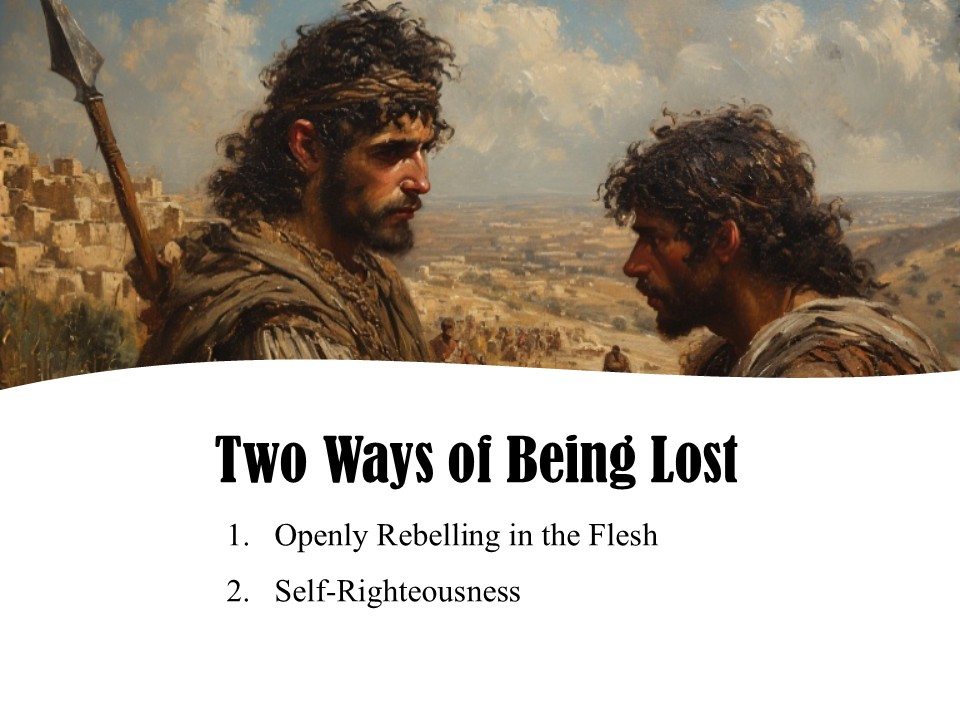
- Openly Rebelling in the Flesh. The one who simply chooses to reject God and go on his own to indulge in his flesh.
- Self-Righteousness. Because of his longtime obedience to the rules, he deserved all the grace and the love that’s being shown to his brother. The older son represents the Pharisees who are “lost” even while staying at home believing that their inheritance was earned because of their adherence to the law. He resents grace to others.
This is an illustration of how self-righteousness robs a person of true joy and love in life, because he fails to really understand grace. This older brother cannot rejoice in his lost brother’s return because he fundamentally believes in legalism over grace and compassion. He fundamentally rejects the idea of grace because he thinks love and praise is earned through one’s consistent adherence to the law. Thus, his self-righteousness inherently alienates him from everyone else because he is all about himself meeting the requirements of the law without any concern for anyone else.
And in this entire process he has failed to truly know his father. He misunderstands his father’s heart and the very nature of grace. He sees his relationship as a transaction (“these many years I served you… you never gave me a kid“) rather than embrace the nature of grace and unconditional love.
Let’s consider the father in this story, because in him, we see many attributes of God’s character. I have a list of 6 Attributes.

- Generous and Respectful of Free Will. When the younger son makes the outrageous and insulting demand for his inheritance while the father was alive (tantamount to wishing his father dead), the father granted his request without a single word of rebuke (v. 12).
- Patient and Longsuffering. When the son was “yet a great way off, his father saw him (v. 20), which implies the father was patiently waiting, watching, and hoping for his son’s return. He was alway scanning the horizon illustrating the patient longsuffering of God and His desire to see us return to Him as one of His children.
- Proactive and Overwhelmingly Compassionate: When he saw his son “a great way off,” the father “was moved with compassion, and he ran, and fell on his neck, and kissed him” (v. 20). The father’s act of running shows unbridled eagerness, humility, and overwhelming love. His embrace and kisses are immediate signs of unconditional acceptance and love, even before the son could open his mouth. The father prioritized their relationship over the water under the bridge, which illustrates God’s desire for reconciliation with everyone.
- Unconditional Forgiveness and Restoration. He interrupted his son’s rehearsed confession (v. 22). He immediately commands his servants to bring the best robe, a ring, and sandals, and to prepare the fatted calf for a celebratory feast (vv. 22-23). This is radical forgiveness that can only speak to endless love that is truly divine in origin. He doesn’t lecture him, or shame him, or impose penance. He sets about restoring him as his son – back to his full status, with all dignity.
- Joy and Celebration over Repentance. The entire focus shifts to a celebration of his repentance, just like Heaven itself. He said, “Let us eat, and be merry: For this my son was dead, and is alive again; he was lost, and is found” (vv. 23-24). Music and dancing follow (v. 25). The father embodies rich, boundless joy over the return of his lost son. His joy was public and exuberant modelling the very joy that is in heaven (Luke 15:7, 10) over one sinner who repents.
- Finally, consider how the father treated the other son. He was Patient and Persuasive with the Self-Righteous. When the older son refuses to join the celebration, the father “came out, and entreated him” (v. 28). He patiently explained his reasons for celebration and lovingly reminds the older son of his secure place (“Son, thou art ever with me, and all that I have is thine,” vv. 31-32). Even with the resentful and self-righteous older son, the father demonstrates patience, gentleness, and a desire to persuade through love. He seeks to draw him into the joy and understanding of grace, rather than condemning him for his selfish bitterness. This reflects God’s patient appeal even to those who are “lost” in their own self-righteousness, desiring all His children to share in His joy and understand His heart.
In essence, the father in the Parable of the Prodigal Son is the quintessential representation of God and His overwhelming love and grace. We see in him unconditional acceptance of the repentant, his proactive compassion to them, His willingness to extend to them full restoration of dignity and status in His family. There is in Heaven just as it is in the Father, joy in reconciliation.
 SUPPLY OF GRACE
Leave a comment