

I’ll bet most of our readers know that the Bible word “dispensation” is a translation of the Greek word “oikonomia.” “Oikos” is “house”, and “nomos” is “law or rule”. The combination of these two root words literally translates to the “law of the household” or “household management.”
Or as most books say, “stewardship.” Same difference.
This is a special privilege for the servant. This is a great position of administration in the master’s house.
So “oikonomia,” which means stewardship was translated as “dispensation,” which primarily means the dispensing of something. There’s nothing wrong with that translation, but for me, the pairing always felt a bit unusual that requires a little bit of thought.
A lot of books and pastors would then talk about how a steward, as part of his role, would dispense things in a household. For me, perhaps the most memorable illustration of a steward dispensing things in house came from Pastor Jordan in his Ephesians series. He said, “A faithful wise steward takes the meat that the master of the house has provided for the people in the house, and he gives it to them at the proper time and in a proper way, fully cooked, set out, and ready to go. That’s good, isn’t it? Can you see ‘dispensationalism’ in there? It is not a smorgasbord of mixing it all up and just giving you goulash. It is not taking chocolate pudding and mixing it with English peas and then pouring it all over roast beef. I like all those things rightly divided, but I don’t want them all mixed together… The steward is the person, and he has a stewardship, a dispensational responsibility. The verb ‘dispense’ means ‘to give out’. Isn’t that what the steward is doing? He is giving them their portion of meat in due season. His job, his responsibility is the dispensation.”
That is hilarious, fun, and right on. I have always loved that.
I would add just a couple of thoughts to what Pastor Jordan said. He was absolutely correct in everything he said. We also know that a steward did more than dispense things in a house. A steward was usually in charge of the finances, too. He oversaw the staff – all the other fellow-laborers. He was responsible for procuring provisions, like food and clothes. He had to care for the master’s property, and he had to himself act in a manner that was in his master’s best interest.
I would suggest that one of the big mistakes we have all made over the years has been to forget Webster’s 2nd definition of dispensation, because dispensation means more than just the dispensing of things. Dispensation also means “The granting of a license” in the sense of being given a special role, or a special privilege that is not available to everyone else. I think Paul absolutely had this idea in mind when he wrote “oikonomia.” This idea of a special role, or responsibility, or a unique privilege pairs so very well with the idea of stewardship.
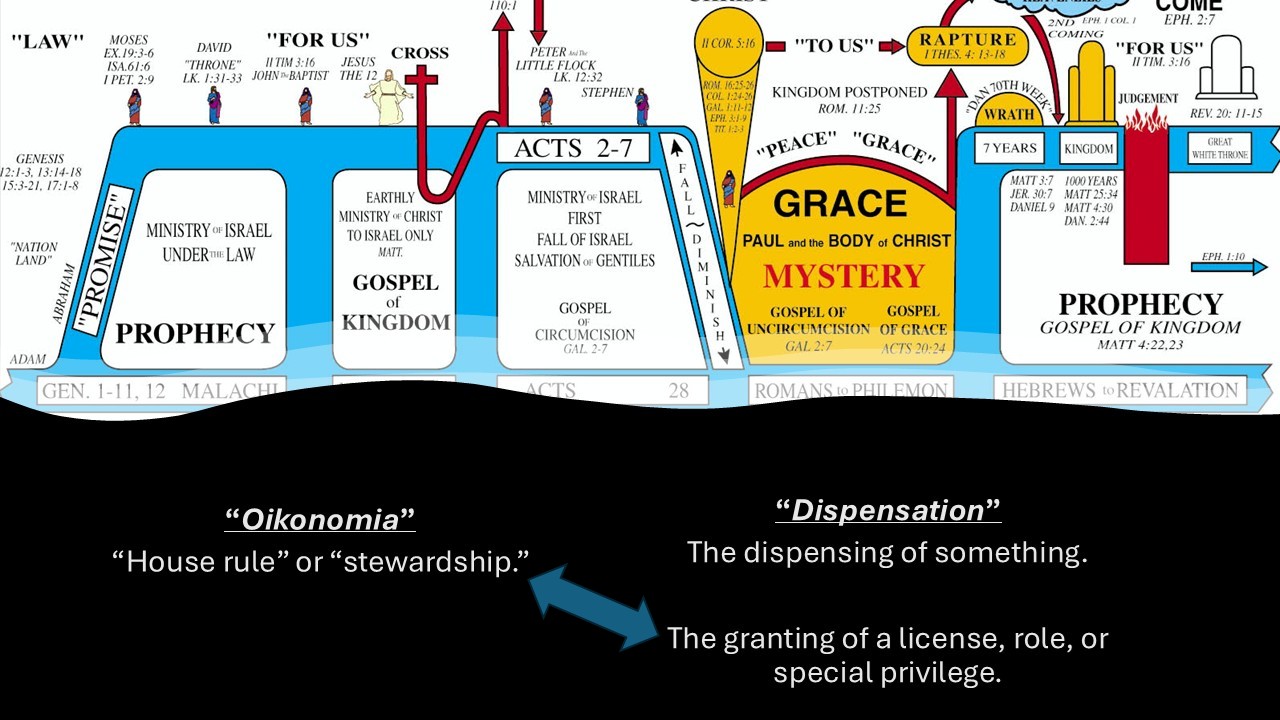
Paul was absolutely given a special role and a unique privilege in His Master’s house and that was, in essence, a stewardship over the grace of God.
What did he mean when he said the grace of God?
By grace of God I think he means the entire body of revelation God had given him. It’s not like Paul is dispensing God’s grace on God’s behalf. God is still dispensing all of His own grace Himself. Paul is merely a steward over that body of information given to him about the grace of God being extended to all of mankind today. Paul merely proclaimed that information, the means by which everyone could receive God’s grace from God directly, which is through the Gospel.
Yet, Paul was also a steward in the same sense as most stewards. He didn’t just dispense things like the Gospel. Paul also in charge of the ministry finances (by tent-making). He oversaw that staff – all of his fellowlaborers, all the churches, and the church leaders. He procured provisions for their spiritual growth – by writing edifying epistles. He took care of the master’s house, the church (1 Tim. 3:15). He also acted in his master’s best interest just as any good steward would do.
So, for me, yes, dispensation means a dispensing of things, but I wouldn’t let that be your only definition of the word, because you’d be pigeon-holing yourself into a narrow view. I think it’s healthy to embrace both definitions of dispensation to appreciate the fulness of what Paul is saying. Dispensation is ultimately about the great role Paul had been given.
I remember growing up hearing people say, “Dispensation is not a period of time. In the Greek it is a stewardship.” That is very true. However, I’d also argue that time is a nuanced aspect of stewardship. We know that every stewardship ends at some point. That stewardship is going to last for as long as that person occupies that role. No person lives forever, which means that every stewardship will last for a limited period of time. But it’s true. The emphasis in the definition in the Greek is stewardship, not time.
Thus, the phrase, dispensation of the grace of God is not a reference to a specific period of time but a divine assignment or unique role. Paul is saying that God had entrusted him with the management of a specific ministry — a sacred trust to be a steward of the grace of God.
When Paul says grace of God, he’s not saying he’s in control of God’s grace. He’s saying he’s a steward of the body of revelation given to him about God’s grace today.
So when Paul says the dispensation of the grace of God, I’d suggest he’s talking about his divinely appointed role of ministry about God’s grace that is being extended to lost Jews and Gentiles and that is, reconciliation to God through the Gospel of grace. “The dispensation of the grace of God” is truly about Paul’s stewardship over the body of revelation about God’s grace to us today. Paul’s stewardship is to manage and distribute that Gospel, as well as all the doctrines surrounding God’s overwhelming grace to all of us today. He is to be a steward in every sense – manage the money, oversee the staff, take care of God’s house, and act in the best interests of his Master in Heaven.
[This was part of a message I gave on Sunday.]
 SUPPLY OF GRACE
Leave a comment