

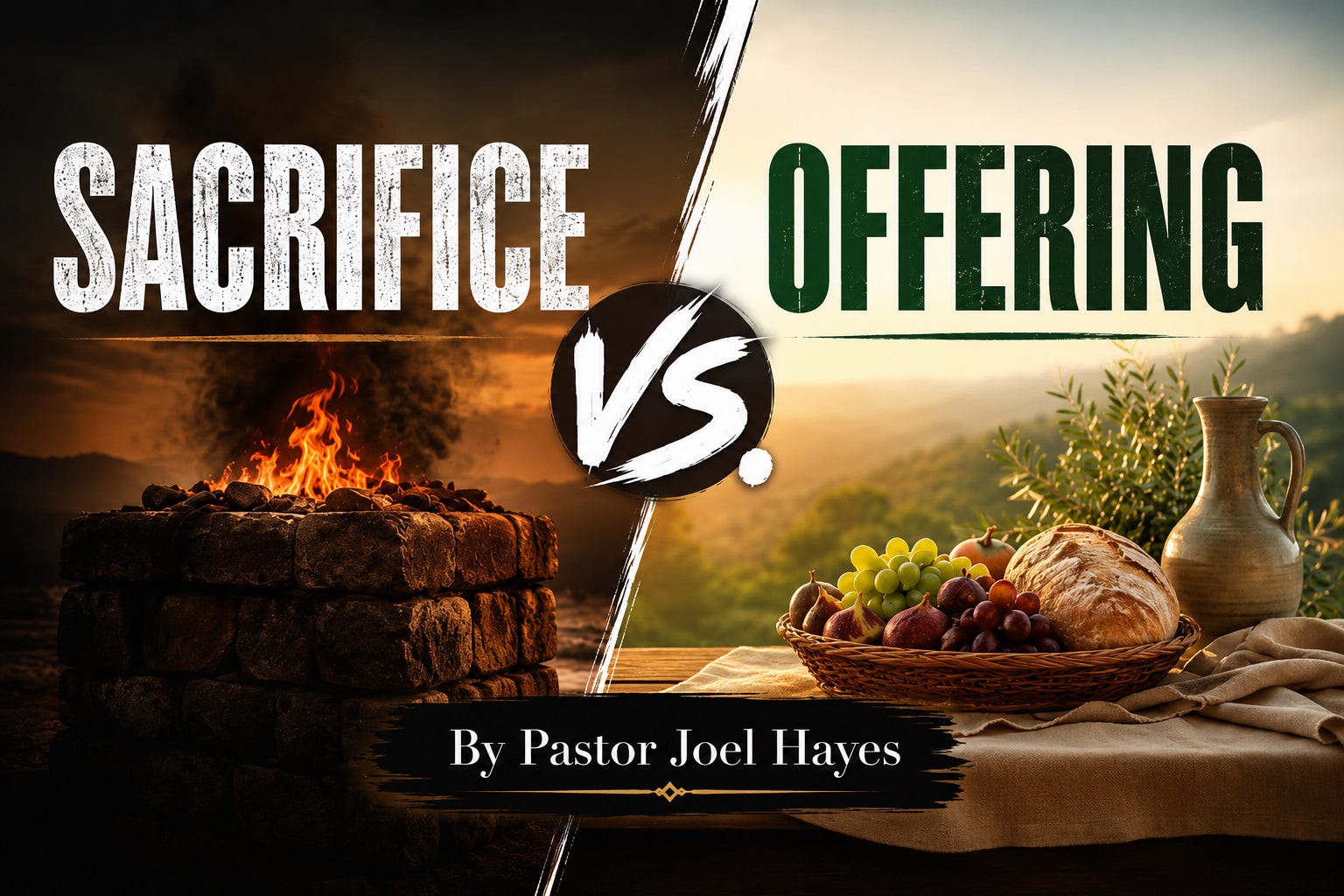
“And walk in love, as Christ also hath loved us, and hath given himself for us an offering and a sacrifice to God for a sweetsmelling savour” (Eph 5:2).
It’s amazing to me that Paul speaks here of an offering and a sacrifice as if the Ephesian Gentile readers already had a basic understanding of the sacrificial system in the OT.
Under the law, there’s a distinction between offering and sacrifice. You can sum it up like this: all sacrifices are offerings, but not all offerings are sacrifices.
An “offering” is a broader category. A “sacrifice” is a specific kind of offering. An offering was anything presented or gifted to God. A sacrifice was an offering that required the death of an innocent life through the shedding of blood.
Every sacrifice was an offering, but many offerings didn’t involve any blood.
Offerings could include all kinds of things like grain, flour, olive oil, wine, incense, precious metals, or other gifts brought in worship. The primary idea of an offering was an expression of one’s dedication, one’s thanksgiving, fellowship, worship, and devotion to God. An offering represented the worshiper bringing the fruit of his labor and presenting it to God as an expression of gratitude, service, and submission.
A sacrifice, however, is a sacrificial victim whose life is taken to atone for another. A sacrifice required blood. A bull, a sheep, a lamb, or a dove would have its blood shed. The emphasis was atonement or substitution for the consequence of sin.
Because sin brings death, a life had to be surrendered in the sinner's place. The sacrifice testified that the wages of sin was death and that an innocent substitute had died on behalf of the guilty for sin to atone for the sin for which the consequence was death.
I’d argue that the sacrificial system had nothing to do with justification. Their justification was always by faith (Gen. 15:6, Rom. 4:2-3). But the sacrificial system had to do with staying God’s judgment here on Earth for mistakes in their walk. And that sacrificial system existed to teach Israel and all of us the principles of substitutionary atonement, which would help us understand how Christ had taken away our sins on the cross.
When Paul says that Christ gave Himself as “an offering and a sacrifice,” he is saying that Jesus fulfilled both types. Christ was the offering. His entire life was presented to the Father in perfect obedience to His will. Christ's entire life was one continuous offering of obedience and submission to the Father. Every thought, every word, every action, every moment of His earthly ministry was wholly devoted to doing the Father's will.
And Christ was also the sacrifice. On the cross, He did not merely present a holy life. He surrendered that life. His blood was shed. His death occurred. A substitute stood in the place of sinners for the consequence of sin. Christ became the fulfillment of the Passover lamb, the sin offering, the trespass offering, and every animal that ever had its blood sprinkled upon an altar. What those animal sacrifices merely anticipated, Christ accomplished once and for all. He did not just offer Himself. He sacrificed Himself.
This is why Paul uses both terms. These two distinct terms brought together in this verse reveals the fullness of Christ's work on the cross for us. He fulfilled every form of offering one can make to God including the sacrificial offerings.
A Sweetsmelling Savior
This brings us to the phrase “for a sweetsmelling savour.” This goes all the way back to Leviticus, when sacrifices were repeatedly described as a sweet savour unto the Lord. The aroma symbolized divine acceptance. The sacrifice ascended. God received it. God approved it. God was pleased.
Why would He be pleased in the deaths of so many animals for sin?
Because every death pointed the way to Christ and that greater sacrifice to come.
There’s a beautiful progression in Paul's wording in this verse that deserves our attention.
First, “hath loved us”—that is the motive.
Then, “given himself”—that is the action.
Then, “an offering”—that is His willing presentation of Himself to God.
Then, “and a sacrifice”—that is His substitutionary death.
Then we get the phrase, “to God”—that is the recipient of the Lord’s life.
Finally, “for a sweetsmelling savour”—that is the Father's complete acceptance.
Every phrase builds upon the one before it until we arrive at this phenomenal truth that Christ consciously and willingly offered Himself to the Father on our behalf, and His offering was so perfect it accomplished what every animal sacrifice could only foreshadow.