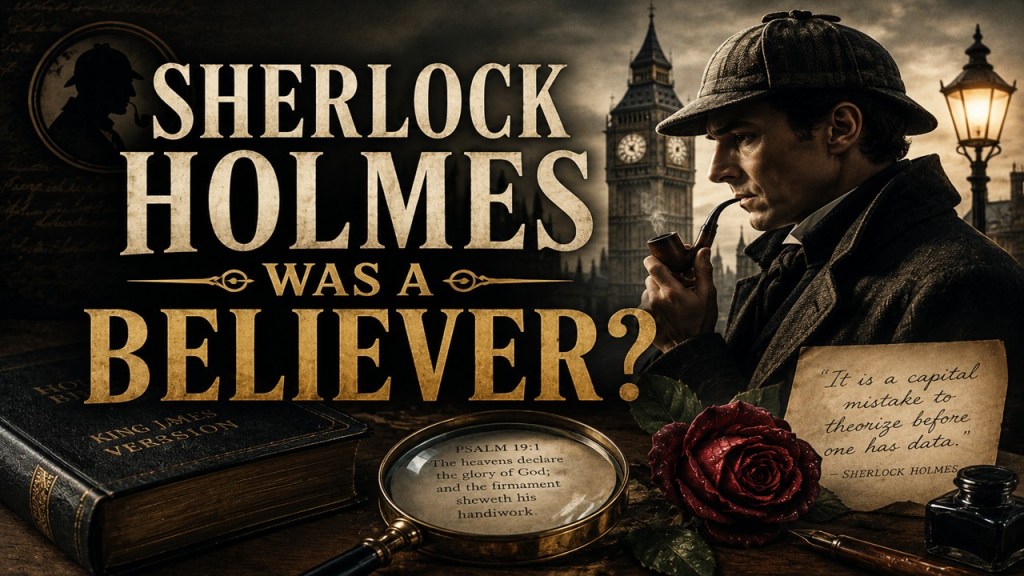
“My name is Sherlock Holmes. It is my business to know what other people don’t know.” (From ‘A Study in Scarlet’).
Today is Sherlock Holmes Day!
I’m a huge Sherlock Holmes fan! I’ve read all the books – twice!
I have never felt that any actor perfectly portrayed Sherlock as he is in the books. He was far more engaging and sociable (at times) than we’ve seen in dramatizations. He could certainly be withdrawn, especially when he didn’t have a case (“My mind rebels at stagnation. Give me problems, give me work…”) But he could also be very sociable at times, too. On those occasions of seeing Holmes engage others sociably, he could be very inspiring, dynamic with people, and even encouraging to people about developing the skills of deductive reasoning, which he was obsessed about mastering.
He could show compassion for victims, anger toward cruelty, admiration for courage, and even mercy at times toward some offenders. He was certainly proud bordering on arrogant, which Watson noticed immediately. He dismissed other detectives as rather unimaginative and slow, but his pride was often mixed with humor as opposed to total outright vanity. (He’ll say to Watson, “What do you make of that, Watson?” Watson would give his analysis. Then Holmes would reply, “Excellent!” Then after a pause, he’ll say, “There are one or two points of difference…” LOL That’s very Holmes.)
Very few dramatizations ever got Watson right. It’s like writers never knew what to do with Watson. Whereas Holmes could be distant or aloof, Watson provided warmth. Sympathy. Ordinary humanity. Without Watson, Holmes is a puffy intellect. With Watson, though, Holmes can be more of a person. Sherlock was the mind. Watson was the soul.
Watson was also tougher in the books than he’s usually portrayed in shows and films. Watson always carried firearms with him. He had no qualms about entering dangerous situations and confronting criminals.
I also love deductive reasoning. And I loved the things Holmes would say about it like, “It is a capital mistake to theorize before one has data. Insensibly one begins to twist facts to suit theories, instead of theories to suit facts” (From “A Scandal in Bohemia”).
Or famously: “How often have I said to you that when you have eliminated the impossible, whatever remains, however improbable, must be the truth?” (From “The Sign of Four”).
In the stories, Holmes might says things like:
- “You have been in Afghanistan.”
- “You are a military doctor.”
- “You came here by cab.”
Then he explains the clues:
- military posture
- tan lines
- mannerisms
- clothing wear
- mud on boots, etc.
Holmes called this deduction, or deductive reasoning, although I’ve read that logicians would say a lot of that is closer to abductive reasoning. So what’s the difference?
Deduction would teach, for example, “If all men are mortal, and Socrates is a man, then Socrates is mortal.” You start with established truths and reach a necessary conclusion.
Induction would teach, for example, “I’ve seen a thousand swans and they’re white; perhaps all swans are white.” You move from observations toward a general rule.
Abduction would be like, “The lawn is wet. It probably rained.” You infer the most likely explanation. Holmes often did this: Mud from this district + military bearing + medical bag + recent war reports = probably army doctor returning from Afghanistan.
But, of course, the big point is: “Given the evidence, what’s the best explanation?”
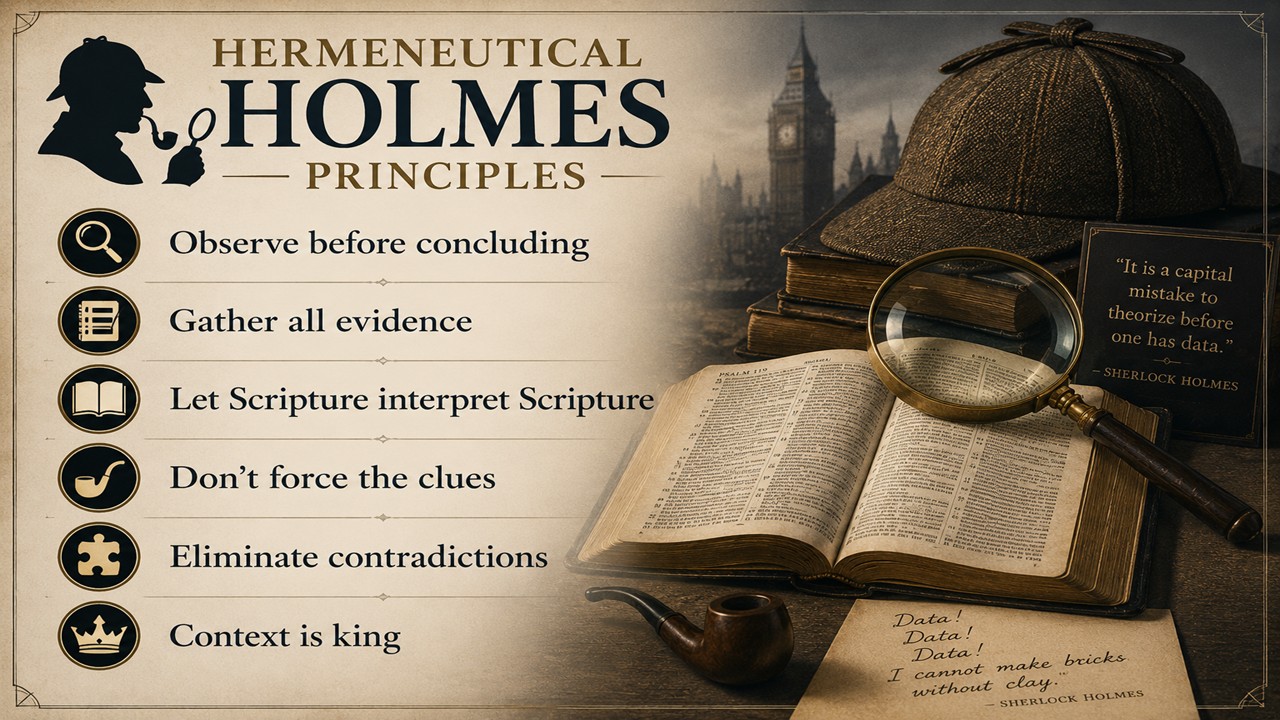
Hermeneutical Holmes Principles?
I’d say good hermeneutics uses something very close to a Holmes-style method. You could almost call it “biblical detective work with rules.” The danger is that many people skip observation and jump straight to conclusions.
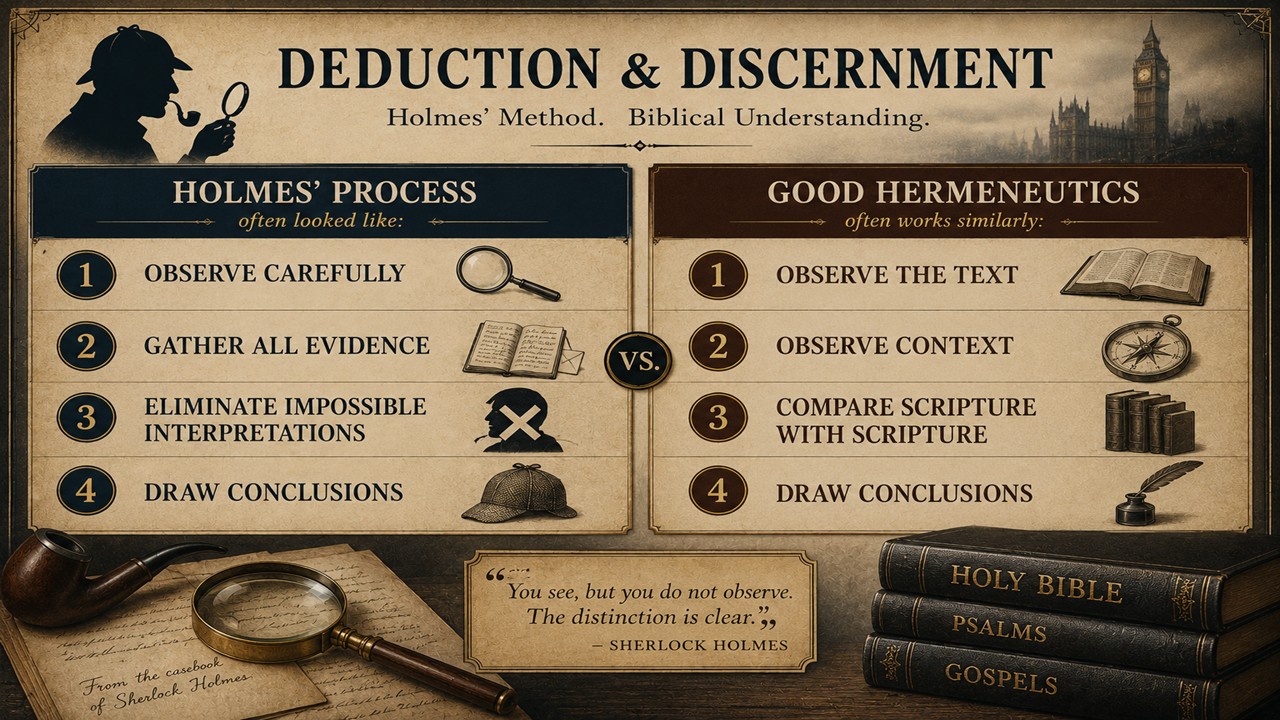
Holmes’ process would be like this:
- Observe carefully
- Gather all evidence
- Eliminate impossible interpretations
- Draw conclusions
Good hermeneutics would work similarly:
- Observe the text
- Observe context
- Compare Scripture with Scripture
- Draw conclusions
The problem is that too many people reverse the process:
- Start with a conclusion
- Hunt for verses
- Ignore contrary evidence
- Declare victory
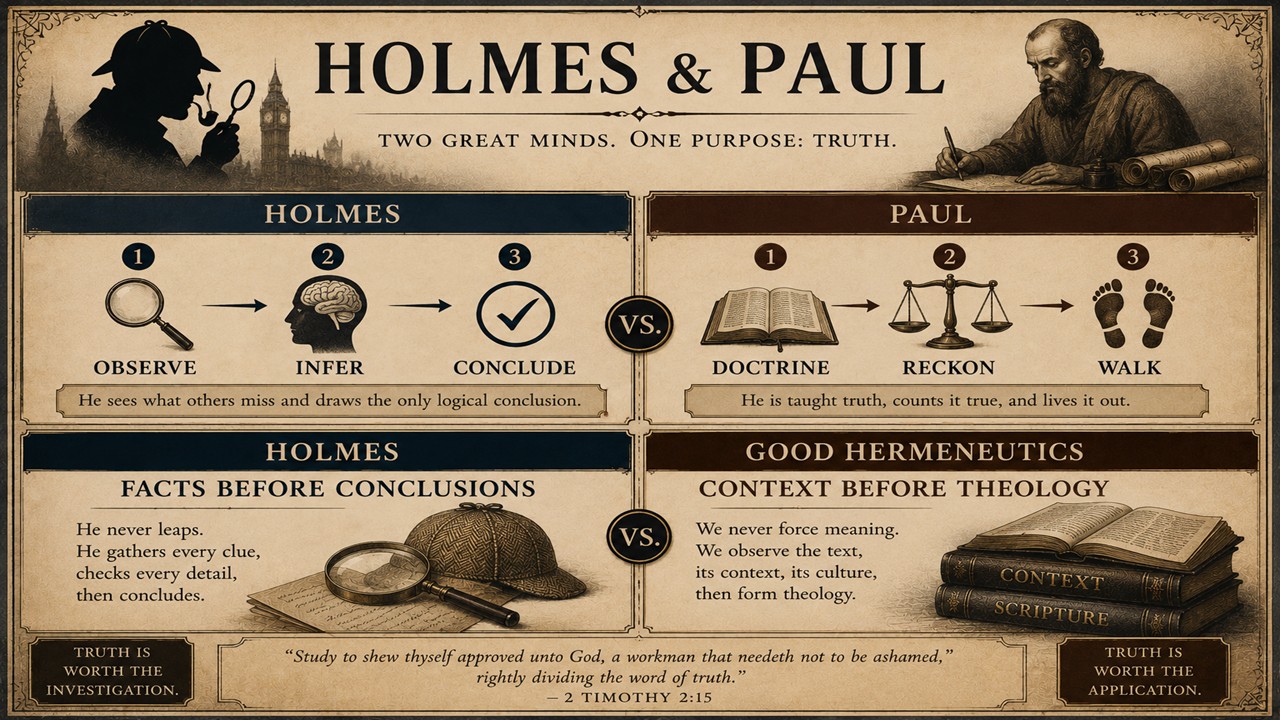
Here’s a nice comparison between Holmes & Paul. Holmes would teach: Observe → infer → conclude. Paul would teach, Doctrine → reckon → walk. Holmes would argue, “Facts before conclusions.” Good hermeneutics would argue, “Context before theology.”
Did you also know that Sherlock Holmes was a believer?
There was the occasional comment in a story about how Sherlock was known to spend a lot of time in the chapel at university. But there was one story in which he argued that logical reasoning and deduction demands that there must be a creator. That story is called “The Naval Treaty.”
A guy begged Sherlock to take on a case that was near impossible to figure out. An innocent man’s life was at stake. The evidence against him was overwhelming. Clearing his name seemed an insurmountable task. This case was so hard, Holmes wasn’t sure he wanted to take it on. It looked hopeless.
He walked to a window and stared at some roses. He got lost in his own thoughts.
He did that sometimes.
Everybody was looking at him thinking, “Are you going to take the case or not?”
Watson walked over to him.
Sherlock said, “There is nothing in which deduction is so necessary as in religion… It can be built up as an exact science by the reasoner. Our highest assurance of the goodness of Providence seems to me to rest in the flowers. All other things, our powers, our desires, our food, are all really necessary for our existence in the first instance. But this rose is an extra. Its smell and its colour are an embellishment of life, not a condition of it. It is only goodness which gives extras, and so I say again that we have much to hope from the flowers.”
I love that. Atheism doesn’t come by reason. Atheism is the abandonment of reason (Psa. 14:1). We know that DNA molecules contain all the genetic instructions to form a living being. How can genetic instructions about how to create living beings come by chance and not from God? How can physical atoms and molecules create on their own human consciousness, which has no physical existence? Animals have a law in their nature but no ability to reason the morality of what they do. They do what they do by the laws stamped upon their spirits from a higher power. But we humans have a conscience, a moral compass. Why is that? Is not a conscience evidence of the morality and holiness of God? No nation ever existed in which all the people were natural atheists, because we all instinctively know God exists just as we know that all motion has a beginning, that there is no effect without a cause, and that order does not spring from chance. Every life is born. Every life dies. So from whence came our beginning? We have always known: “In the beginning God created the heaven and the earth” (Gen 1:1)
Now logical reasoning would demand the existence of a Creator, but deductive reasoning would inform us that flowers assure us of the goodness of our Creator, because flowers are a total bonus in life, which is cause to always have hope. Necessities explain survival. Extras suggest generosity on the part of the Creator. Why would existence contain beauty beyond utility? Why does the world contain delight and not merely function?
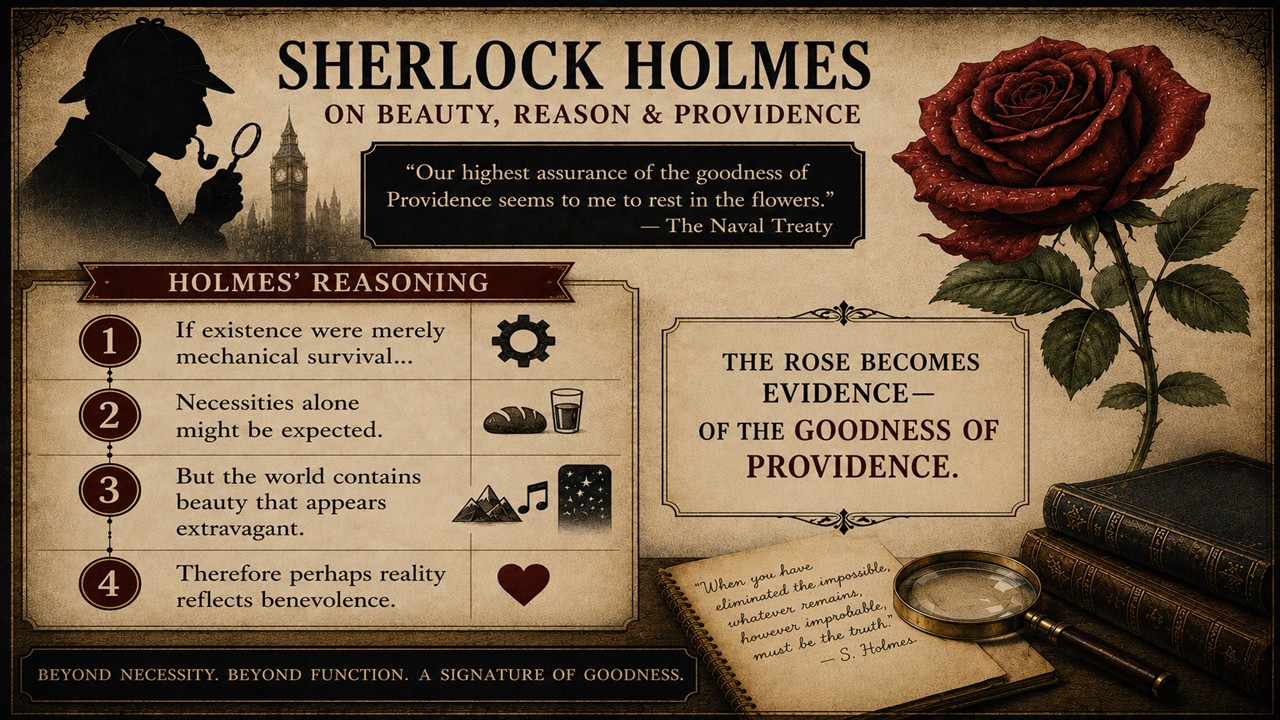
He is essentially reasoning like this:
- If existence were merely mechanical survival…
- Necessities alone might be expected.
- But the world contains beauty that appears extravagant.
- Therefore perhaps reality reflects benevolence.
The rose becomes evidence — of the goodness of Providence.
I also love the fact that he says, “There is nothing in which deduction is so necessary as in religion.” That is very Holmes. He isn’t saying, “Believe without thinking.” He’s saying, “Reason carefully.” For Holmes, religion should not merely rest on inherited tradition or sentiment. It should be reasoned, observed, examined the way he examines… footprints:
- observe
- infer
- follow implications
And, of course, Sherlock took on the case and saved the man’s life. Come on! This is Sherlock Holmes, you know!
The game’s afoot!


 SUPPLY OF GRACE
Leave a comment