
One night, I purchased an e-book called Faith Forward CEO’s put out by the Barna Research Group, which was about how faith influences leadership styles of Christian executives. I thought, “That might make for an engaging topic for a podcast.”
Some of the points were interesting. “Faith forward CEOs” tend to prioritize vision (80%), culture (73%), productivity (71%), but only 37% feel responsible for employee work-life balance. They also are more likely to be:
- Purpose-driven (90% motivated by impact)
- Values-forward (faith, humility, love)
- Emotionally healthier (less burnout, more hope)
- Mentored (82% have had mentoring)
They also said that there are sometimes feelings of tension between faith and leadership. Their faith is present, but that faith is not always doing the leading. Sounds like a personal problem to me. In any event, only 51% say that their faith actively motivates leadership. It’s influential but often compartmentalized.
So, essentially, the report was saying, “There is a growing group of leaders who want to lead with faith and purpose—but they haven’t fully figured out how to integrate it into business leadership yet.”
I thought, “What would Pauline grace-based leadership look like? What verses would you use to guide a believer wanting to master grace-based leadership in the workplace?”
Here’s a fancy-schmancy chart based on my list.
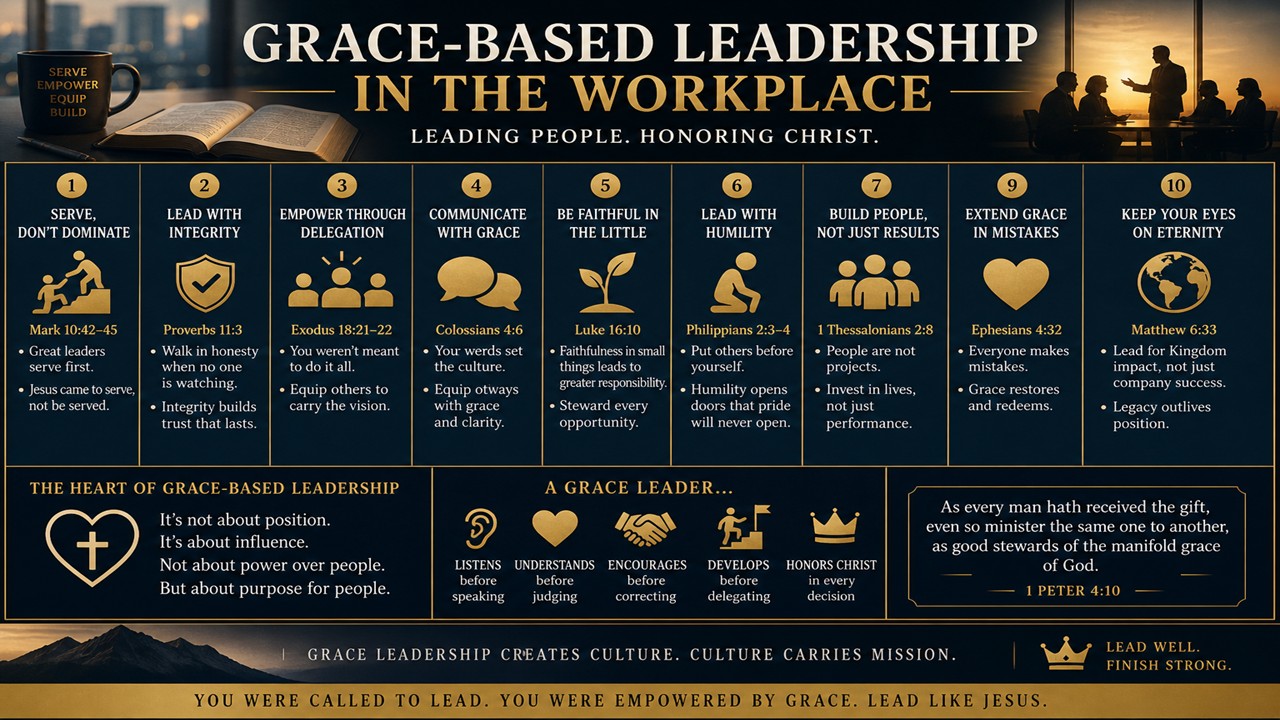
Without further ado, as a thought experiment, here are
10 Principles of Grace-Based Leadership.
1. Identity Before Performance
Ephesians 1-3
I suspect that grace-based leadership begins where Paul begins — in identity. Before there is instruction, there is position. Before performance, there is acceptance.
The leader who understands he is already “accepted in the beloved” would not be driven by insecurity, although he would happily work hard to prove himself in the sense of demonstrating his skills/abilities/leadership. He wouldn’t build an environment designed to validate his worth or chase outcomes to satisfy his ego. Instead, he leads from a settled place of worth within himself. That stability should produce a calm, non-anxious presence — one that is not threatened by talent, not insecure, not reactive under pressure, and not dependent on validation.
2. Building Up People
Ephesians 4:16
Wouldn’t Paul’s teachings in Ephesians 4 reframe one’s style of leadership as supply to others to perform well like the Body of Christ, as opposed to taking over the spotlight for oneself? Grace leadership would not be about centralizing power — it is about distributing the responsibilities and supporting those who have those responsibilities. The grace leader would tend to want to equip, to develop others, and to delegate.
He knows he is not indispensable by design. In fact, he knows his organization’s success is measured by how well all the others function (without him). I’ve seen how micro-managing control freaks at the top can totally disrupt a company, but supply and support from the head would instead strengthen those in the organization to perform better. Where micromanagement stifles, empowerment multiplies.
3. Accountability Without Fear
Romans 8:1
Believing in Grace does not mean you don’t have standards. In fact, grace requires standards met in the workplace, but grace could transform how those standards are enforced. In a grace-based culture, failure still has to be addressed. Mistakes still have to be corrected, but a leader would separate performance from personal worth. That leader would create an environment where people can admit error without fear of humiliation. This produces something rare in modern workplaces: psychological safety without moral compromises.
On the other hand, a leader might treat a poor performer as a pastor might treat a heretic – after the first and second admonition reject (Titus 3:10).
4. Emotional Stability Under Pressure
Colossians 3:12-13
Wouldn’t Paul’s call to forbearance and long-suffering translate directly into great leadership composure under pressure? Grace leaders are not governed by emotional volatility. They would not explode under stress, retaliate in conflict, or lead through intimidation. Instead, they function well under pressure. Their steadiness would embody the emotional thermostat of the organization.
5. Integrity Beyond Optics
2 Corinthians 8:21
Naturally, grace does not accept moral looseness — but inspires integrity. The grace leader would not be driven by appearances, branding, or public perception. He provides “honest things” not only in the sight of men but also before God. That means no manipulation, no deceptive practices, and no hiding behind technical legalities. Perfect transparency. His ethics will not be compromised under any circumstance.
6. Authority as Stewardship
1 Corinthians 4:1-2
We would have to conclude from 1 Cor. 4:1-2 that Paul frames leadership as stewardship, not ownership, wouldn’t we? Grace leaders would not view their position as something they possess, but it’s something entrusted. They lead with a sense of accountability — not just to shareholders, but also to God. This should produce humility in authority, long-term thinking, and a refusal to build personal empires at the expense of others.
7. Excellence Without Legalism
Colossians 3:23
I’m sure we would all agree that grace-based leadership would produce a strong work ethic — but not a crushing one. Excellence is pursued, diligence is honored, and competence is rewarded. Yet performance is never confused with identity. The grace leader would avoid both extremes: laziness on one side and performance-based worth on the other. The result would be a culture of intrinsic motivation rather than external pressure.
8. Generosity Over Exploitation
2 Corinthians 9
Where grace is understood, generosity follows, right? The grace leader would resist the instinct to extract maximum value at the expense of people. He would seek fairness. He’d invest in others, and hold up both profit and generosity. He’d accommodate personal needs as much as possible. I don’t mean performative generosity for branding purposes, but a quiet, consistent liberality simply because he’s a grace believer.
9. Influence Without Coercion
Acts 17:2-4
Grace leadership would, I think, understand the distinction between influence and control. This leader would not awkwardly force spirituality into corporate structure. Instead, a grace-based leader would live out his/her conviction personally and consistently. Like Paul in pagan cities, a grace-based leader would lead by example with clarity, and without awkwardly advocating the gospel at all the wrong times.
10. Strength Without Harshness
2 Timothy 2:1
I suspect grace is often mistaken for weakness — but Paul presents it as strength. Grace leaders can make hard decisions. They absolutely uphold standards. They totally protect the organization. But they would do all these things without the kind of cruelty you might see in unbelievers, without an ego to bruise, and without unnecessary severity. Their authority is clear and not oppressive.
Conclusion
At the end of the day, I’d say grace-based leadership isn’t a technique — it’s a byproduct of identity. When a leader knows who he is in Christ — accepted, complete, and secure — he is not leading from a place of insecurity or feel he has to dominate to prove his worth. He can build people up, correct without crushing, lead without harshness, and influence without coercion. What Barna observed as “faith-forward” is a step in the right direction — but Pauline grace takes it deeper. It doesn’t just inform leadership. It transforms the leader. And from that transformation flows a workplace marked by his steadiness, integrity, clarity, and quiet power. Not trying to Christianize the system. Not trying to take over Rome. But manifesting Christ in the middle of it all — being faithful, consistent, without apology.

 SUPPLY OF GRACE
Leave a comment